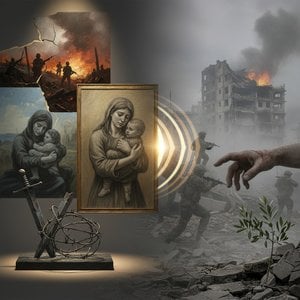
A Life Forged in Resistance: The Art of Svay Sareth
Svay Sareth’s art is inseparable from the tumultuous history of Cambodia, a narrative woven into the very fabric of his sculptures, installations, and profoundly moving performance pieces. Born in 1972 in Battambang during a period defined by political upheaval and violence—a conflict that would cast a long shadow over his formative years—Sareth’s early life was marked by displacement and survival. He began to create as a teenager within the confines of Site 2, a refugee camp bordering Thailand, an experience he describes as existing in “a void nationality…a time and place you imagine escaping from.” This initial impulse to make art wasn't merely aesthetic; it was a vital act of bearing witness, a symbolic attempt at escape, and a nascent dream of change amidst unimaginable hardship. Drawing and painting became daily rituals, offering a fragile space for self-expression in the face of psychological and physical trauma.From Refugee Camp to Artistic Voice
The end of the wars didn’t signify an immediate return to normalcy, but rather the beginning of another chapter of rebuilding. Sareth co-founded Phare Ponleu Selepak in 1994, a non-governmental organization and art school in Battambang that continues to provide opportunities for marginalized youth through artistic education. This commitment to community and empowerment became a defining characteristic of his practice. In 2002, he pursued formal studies at the University of Caen in Normandy, France, earning a Diplôme National Supérieur d’Études des Arts Plastiques (MFA) in 2009. Returning to Siem Reap, Sareth established himself as a unique and powerful voice within the Cambodian art scene, one deeply rooted in personal experience yet resonating with universal themes of memory, resistance, and identity.Materials of War, Processes of Catharsis
Sareth’s work is immediately recognizable for its deliberate use of materials intrinsically linked to conflict—metals, uniforms, camouflage fabrics, and actions demanding immense physical endurance. He doesn't simply depict war; he embodies it through his chosen mediums. This isn’t a practice of historical reenactment or voyeurism, but rather a complex exploration of survival, adventure, and the often-futile search for power. His sculptures frequently incorporate elements reminiscent of Cambodia’s rich Buddhist heritage, juxtaposing them with stark reminders of its violent past. More recently, his work has turned towards confronting the present, appropriating and dramatizing public monuments that carry the weight of contentious political histories.Performance as Embodiment
Perhaps most striking is Sareth's dedication to durational performance art. His seminal piece, *Mon Boulet* (2011), exemplifies this approach. For six days, he traversed a 250-kilometer stretch of Cambodian landscape, dragging an enormous, two-meter wide, 80-kilogram metal sphere—a “burden” representing the weight of history and personal trauma. This act wasn’t simply about physical endurance; it was a public intervention, a visceral embodiment of struggle and resilience. Other performances involve equally demanding actions, often requiring him to confront his own body as a medium for questioning authority and challenging established order. The performative dimension extends beyond live actions, encompassing the very presentation of his work, inviting viewers to actively engage with the complex issues he addresses.Recognition and Lasting Significance
Svay Sareth’s contributions have garnered significant recognition both within Cambodia and internationally. He was awarded the Prudential Eye Award for Best Emerging Artist in 2016, solidifying his position as a leading contemporary artist from Southeast Asia. His work has been exhibited at prestigious venues including the 10th Asia Pacific Triennial of Contemporary Art, the Biennale of Sydney, and the Gwangju Biennale. Beyond accolades, Sareth’s lasting significance lies in his ability to transform personal trauma into powerful statements about collective memory, political responsibility, and the enduring human spirit. He is not merely an artist documenting history; he *is* a part of it, actively shaping its narrative through courageous self-expression and unwavering commitment to peace and reconciliation. His co-founding of Blue Art Center further demonstrates his dedication to fostering artistic growth and dialogue within Cambodia, ensuring that future generations have the space to confront their past and build a more hopeful future.Q&A
Svay Sareth의 연도별 활동 기록이 있나요?
Svay Sareth의 연대기는 작가의 활동 시기별로 분류된 작품들을 연대순으로 보여주는 스크롤 방식의 타임라인입니다.
Svay Sareth의 작품 중 몇 점을 둘러보실 수 있나요?
전체 작품 보기 페이지에서 Svay Sareth의 작품 작품 1점점을 만나보실 수 있습니다.
Svay Sareth은(는) 어느 시대의 작품을 남겼나요?
Svay Sareth은(는) Contemporary 시대에 활동했습니다. 이 시기는 역사적 맥락 속에서 작가의 예술적 위치를 보여줍니다.
키워드별로 분류된 Svay Sareth의 작품은 어디에서 볼 수 있나요?
Svay Sareth의 작품은 아티스트의 키워드별 탐색 페이지에서 키워드별로 찾아보실 수 있습니다. 각 키워드를 통해 관련 작품들을 모아 감상하실 수 있습니다.