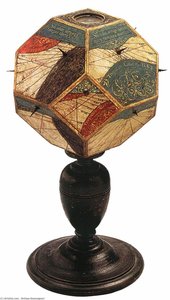
The Cartographer of the Soul and the City
In the golden twilight of the Italian High Renaissance, where the boundaries between scientific inquiry and spiritual devotion often blurred, lived Stefano Buonsignori. A figure emerging from the quiet cloisters of the Olivetan Order, Buonsignori was far more than a mere monk; he was a visionary who possessed the rare ability to translate the physical grandeur of Tuscany into the precise language of geometry. Born in Florence around 1540, his early life was shaped by the contemplative silence of Monte Oliveto Maggiore. This monastic upbringing, far from isolating him from the world, provided the disciplined eye necessary for his later triumphs. The meticulousness required by liturgical duties and the study of sacred texts likely nurtured the profound patience and observational rigor that would eventually define his cartographic masterpieces.
The trajectory of Buonsignori’s life took a monumental turn when he was summoned from his monastic seclusion to serve the Medici court. In 1576, Grand Duke Francesco I de' Medici recognized in this humble friar a talent that could bridge the gap between art and cosmography. Appointed as the Grand Ducal Cosmographer, Buonsignori was tasked with an ambitious intellectual project: to document the expanding glory of the Florentine state through visual precision. This period marked his transition from a man of prayer to a man of the world, though he never truly abandoned the spiritual depth that informed his work. His art was not merely about lines and borders; it was an attempt to capture the divine order reflected in the terrestrial landscape.
A Masterpiece of Perspective and Precision
The pinnacle of Buonsignori’s artistic and scientific achievement is undoubtedly the Bonsignori Map of Florence. Produced between 1576 and 1584, this work represents a watershed moment in the history of cartography. Moving away from the stylized, often inaccurate sketches of his predecessors, Buonsignori employed an axonometric projection that offered a breathtakingly clear and semi-perspectival view of the city. This technique allowed for a simultaneous appreciation of architectural detail and urban layout, creating a sense of depth that felt both immersive and authoritative. It was a triumph of humanist ambition, where the mathematical certainty of the Renaissance met the aesthetic elegance of Florentine design.
To gaze upon his map is to witness Florence at its most triumphant. Through his skilled hand, one can trace the intricate veins of the city, from the monumental structures of the Palazzo Vecchio to the burgeoning fortifications of the Belvedere. His work was not a static record but a living document of change; later editions even incorporated new landmarks like the Fountain of Neptune and the Equestrian Monument of Cosme I. This ability to weave contemporary progress into a cohesive artistic vision ensured that his maps were both historical archives and celebrations of Medici power. His collaboration with engravers like Bonaventura Billocardi allowed these intricate visions to be disseminated, spreading the prestige of Florence far beyond the borders of Tuscany.
Legacy of the Florentine Visionary
The significance of Stefano Buonsignori extends far beyond the technical accuracy of his maps. He stands as a symbol of the Renaissance ideal—the polymath who could navigate the complexities of both the celestial and the terrestrial. His work contributed to a broader cultural movement that sought to categorize, understand, and ultimately celebrate the natural and man-made worlds. By applying the principles of geometry to the topography of his homeland, he helped create a visual language for power, stability, and urban identity.
Even as the era of the great Renaissance cartographers began to wane, the impact of Buonsignori’s precision remained. His contributions to the Sala delle Matematiche in the Uffizi, through his chorographies of the Florentine and Sienese domains, left an indelible mark on the intellectual landscape of Italy. Today, we remember him not just as a monk or a servant of the Grand Duke, but as the artist who gave Florence a face that was both mathematically perfect and poetically profound. His legacy is etched into the very streets he mapped, a permanent testament to a life spent finding the divine in the details of the earth.