Stasys Ušinskas: A Pioneer of Lithuanian Modernism
Stasys Ušinskas (20 July 1905 – 14 June 1974) stands as a singular figure in Lithuanian art history—a “father of Lithuanian stained glass art,” as he’s rightfully recognized—whose multifaceted talent spanned painting, scenography, animation, puppetry, and decorative glassworks. Born in Pakruojis, Lithuania, to Juozas Ušinskas, a stonebreaker, and Sofija Ušinskaitė, his early life instilled within him a profound appreciation for craftsmanship and observation of the natural world—influences that would permeate his artistic vision throughout his prolific career. His formative years included time spent in the United States before returning to Lithuania in 1914, where he pursued formal education at Šiauliai Gymnasium, laying the groundwork for his subsequent studies at Kaunas Art School and later at Académie Julian in Paris.Early Artistic Influences & Parisian Training
Paris proved pivotal in shaping Ušinskas’s artistic sensibilities. The Académie Julian exposed him to the burgeoning modernist movement—particularly Cubism and Art Deco—introducing him to influential artists like Henri-Marcel Magne, whose lectures profoundly impacted his understanding of theatrical design and visual storytelling. This exposure fostered a collaborative spirit, encouraging him to engage with Aleksandra Ekster, who championed experimentation and pushed him toward exploring new artistic mediums. Notably, Ekster’s influence encouraged Ušinskas to delve into the realm of puppetry, recognizing its potential as a vehicle for conveying complex narratives and engaging audiences on an emotional level—a fascination that would define much of his later work.A Diverse Artistic Output: Painting & Stained Glass
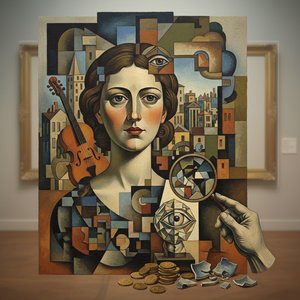
Ušinskas's artistic output was remarkably varied. His paintings exemplify modernist principles—characterized by geometric abstraction, flattened perspectives, and bold color palettes—often reflecting a preoccupation with themes of nature and human emotion. “The Bather,” completed in 1931, exemplifies this style perfectly: a stylized nude rendered in warm tones against simplified geometric shapes, embodying the spirit of Lithuanian Art Deco. However, Ušinskas’s legacy is indelibly etched in stained glass art. He revolutionized Lithuanian stained glass production, establishing it as a distinct artistic discipline and elevating its aesthetic standards. His meticulous craftsmanship combined with innovative compositional techniques—drawing inspiration from Cubist fragmentation and Art Deco ornamentation—created breathtaking artworks that continue to captivate viewers today. The exhibition at the Central State Archives of Lithuania recognized his contribution as an object of documentary heritage of national significance, cementing his place in Lithuanian cultural history.Animation & Puppetry: Expanding Artistic Horizons
Beyond painting and stained glass, Ušinskas demonstrated exceptional versatility by venturing into animation and puppetry. He conceived and executed several animated films—including “The Dream of the Fatty”—that showcased his mastery of visual storytelling and experimental filmmaking techniques. His puppet theatre productions were equally ambitious, blending theatrical performance with intricate marionette craftsmanship and imaginative narratives rooted in folklore and mythology. The Kaunas State Puppet Theatre proudly displays Ušinskas’s puppets, a testament to his enduring influence on Lithuanian puppetry tradition. Furthermore, he was recognized as the inventor of the “author’s theatre” and the predecessor of the “artist’s theatre”.Legacy & Recognition
Stasys Ušinskas's artistic vision—characterized by boldness, innovation, and an unwavering commitment to craftsmanship—continues to inspire artists and scholars alike. His pioneering role in Lithuanian stained glass art solidified his reputation as a national icon, while his contributions to animation and puppetry broadened the scope of Lithuanian artistic expression. He served as a teacher at Kaunas Art School and later headed the department of decorative arts at the Lithuanian Institute of Fine Arts, nurturing generations of artists who embraced Ušinskas’s ethos of creative exploration and artistic integrity—a legacy that ensures his enduring significance in Lithuanian cultural heritage.질의응답
주제별로 분류된 Stasys Ušinskas의 작품들은 어디에서 확인할 수 있나요?
Stasys Ušinskas의 작품은 작가의 주제별 아틀라스 페이지에서 주제별로 찾아보실 수 있습니다.
Stasys Ušinskas의 경력은 어떻게 시기별로 구분되어 있나요?
Stasys Ušinskas의 작품 세계를 시간순으로 정리한 기록은 아티스트 연대기 페이지에서 확인하실 수 있으며, 이곳에서는 각 시기별로 분류된 챕터를 따라 작품들을 제작 순서대로 만나보실 수 있습니다.
특정 주제에 따른 Stasys Ušinskas의 작품을 어떻게 찾을 수 있나요?
Stasys Ušinskas의 작품은 아티스트의 키워드별로 페이지에서 키워드별로 찾아보실 수 있습니다. 각 키워드는 관련 작품들을 그룹화하여 보여줍니다.