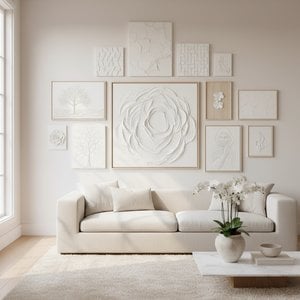
A Life Dedicated to the Essence of Painting
Robert Ryman, born in Nashville, Tennessee, in 1930 and passing away in 2019, wasn’t interested in depicting the world; he was captivated by painting itself. His journey began not with a formal artistic education geared towards representation, but with studies at the Tennessee Polytechnic Institute and George Peabody College for Teachers – foundations that would later inform his disciplined approach. A stint in the United States Army from 1950 to 1952 instilled a sense of structure, perhaps subtly influencing the rigorous self-examination that characterized his artistic practice. However, it was his relocation to New York City in 1952 that proved pivotal. Securing a position as a security guard at the Museum of Modern Art wasn’t merely a job; it was an immersion into the heart of modern and contemporary art. Surrounded by masterpieces from Abstract Expressionists like Mark Rothko, Willem de Kooning, Clyfford Still, and Jackson Pollock, Ryman began to question not *what* could be painted, but *how*.From Jazz Aspirations to Monochromatic Visions
Interestingly, Ryman’s initial artistic ambitions lay elsewhere. He harbored dreams of becoming a jazz saxophonist, even taking lessons with the renowned pianist Lennie Tristano. This musical pursuit wasn't abandoned in vain; it profoundly shaped his understanding of composition and rhythm – elements that would later manifest in the subtle variations within his seemingly austere canvases. The discipline required for mastering an instrument translated into a meticulous approach to painting, where every brushstroke, every layer of paint, held significance. Around 1955, he began experimenting with painting, gradually moving towards what would become his signature style: white-on-white abstractions. This wasn’t simply about reducing art to its most basic elements; it was a radical exploration of materiality, light, and space. He deliberately limited his palette, often employing square canvases or metal surfaces, focusing on the very act of painting and the inherent qualities of the materials themselves.A Materialist Approach: Beyond Minimalism
Ryman’s work is frequently associated with minimalism, but he resisted that categorization, preferring to identify as a “realist.” This distinction is crucial. He wasn't striving for reductive forms or impersonal surfaces; rather, he aimed to present his materials – canvas, linen, steel, aluminum, plexiglas, vinyl, fiberglass, and countless others – at their most honest and direct. His experimentation extended beyond the support itself, encompassing a diverse range of media including oil, acrylic, encaustic, Lascaux acrylic, casein, enamel, pastel, graphite, guache, and enamelac. The *Classico* series, begun in the late 1960s, exemplifies this approach. These works involved attaching heavy white paper to walls with masking tape, painting them with shiny acrylic, then removing the tape to reveal traces of the process – a testament to the act of creation itself. The *Surface Veil* works, starting in the 1970s, further explored transparency and opacity, creating membrane-like effects on fiberglass or cotton/linen supports. He wasn’t interested in illusion; he wanted viewers to experience the painting as an object in space, a tangible entity with its own unique presence.Legacy and Lasting Influence
Robert Ryman's impact on contemporary art is undeniable. He challenged conventional notions of representation, expanded the possibilities of abstraction, and redefined our understanding of what a painting could be. His work wasn’t about depicting something *else*; it was about being itself – a self-referential exploration of the medium. While often categorized alongside minimalists, Ryman transcended such labels, forging his own path and influencing generations of artists who followed. Throughout his career, he exhibited extensively in major museums and galleries worldwide, receiving numerous accolades including election to the American Academy of Arts and Letters in 1994. His legacy isn’t simply a body of work; it's a profound questioning of artistic conventions and an unwavering commitment to the essential qualities of painting. He leaves behind not just canvases covered in white paint, but a lasting invitation to see – truly *see* – the world around us with fresh eyes.질의응답
미술 사조별로 분류된 Robert Ryman의 작품은 어디에서 볼 수 있나요?
Robert Ryman의 작품은 작가의 모든 사조 페이지에서 사조별로 둘러보실 수 있습니다.
주제별로 분류된 Robert Ryman의 작품들은 어디에서 확인할 수 있나요?
Robert Ryman의 주제별 아틀라스는 작가의 작품들을 주제별로 분류하여 보여주는 페이지입니다.
Robert Ryman 작가 작품의 컬러 프로필은 어디에서 확인할 수 있나요?
Robert Ryman 작가 작품의 컬러 프로필은 작가의 팔레트 지놈 페이지에서 확인하실 수 있습니다.
Robert Ryman의 출생 도시와 국가는 어디인가요?
Robert Ryman은(는) United States of America의 Nashville에서 태어났습니다.
Robert Ryman 작가의 작품을 감상할 수 있는 가상 박물관에 방문할 수 있나요?
Robert Ryman의 작품은 작가의 3D 뮤지엄 페이지에 마련된 3D 갤러리에서 감상하실 수 있습니다.
Robert Ryman은(는) 어느 시대에 활동했나요?
Robert Ryman은(는) Modern 시대에 활동했습니다. 이 시기는 역사적 맥락에서 작가의 활동 위치를 보여줍니다.
Robert Ryman의 모든 작품을 어디에서 볼 수 있나요?
본 웹사이트에 등록된 Robert Ryman의 모든 작품은 작가의 모든 작품 보기 페이지에서 확인하실 수 있습니다.
특정 팔레트의 Robert Ryman 작품은 어떻게 찾을 수 있나요?
특정 색상 팔레트의 Robert Ryman 작품을 찾으시려면, 작가의 컬러 팔레트별 페이지를 이용해 보세요.