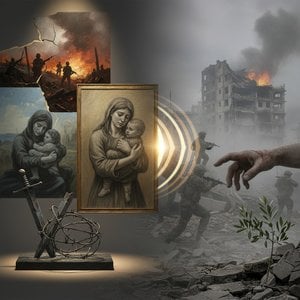
The Lens of Resilience: The Visual Journey of Ramez Habboub
In the heart of the Gaza Strip, where the echoes of history and the weight of contemporary struggle converge, the work of Ramez Habbub serves as a profound visual testament to human endurance. Born in Lebanon and deeply rooted in the Palestinian experience, Habboub has emerged not merely as a photographer, but as a vital witness to the unfolding narratives of his people. His lens does more than capture light; it captures the very essence of survival, finding beauty within the fractures of conflict and dignity amidst the chaos of war. Through his eyes, the viewer is invited into an intimate dialogue with Gaza, moving beyond the headlines to encounter the breathing, feeling reality of its inhabitants.
Habboub’s artistic evolution is a testament to the power of self-directed passion and an unwavering commitment to truth. His early fascination with the intricate textures of Palestinian life—the sweeping landscapes and the quiet, intimate moments of daily existence—laid the foundation for a career defined by sensitivity and detail. As he honed his craft, his work transitioned from purely aesthetic explorations into the rigorous domain of photojournalism. This development was driven by a realization that visual storytelling possesses a transformative potential, capable of challenging conventional global narratives and humanizing those often reduced to mere statistics in the theater of war.
A Narrative of Truth and Human Connection
The professional trajectory of Ramez Habboub is marked by his contributions to some of the most influential platforms of modern journalism. By lending his vision to organizations such as NPR, The Middle East Monitor, and Chronique de Palestine, he has bridged the gap between the isolated realities of Gaza and a global audience. His approach is characterized by an ethical rigor that prioritizes human dignity above all else. Whether documenting the architectural serenity of the Omari Mosque or the raw intensity of life in the Jabalia refugee camp, Habboub maintains a stance of impartiality and respect, ensuring that his subjects are portrayed with the nuance they deserve.
His body of work is remarkably diverse, spanning several critical genres of photography:
- Documentary Photojournalism: Capturing the unfolding political and social shifts within the Palestinian territories.
- Portraiture: Creating soulful, intimate studies of individuals that reveal the strength behind the struggle.
- Landscape and Architecture: Documenting the historical and cultural landmarks that define the Palestinian identity.
- Wildlife and Nature: Finding moments of natural grace even within contested environments.
Legacy and Global Impact
Beyond the individual frames, Habboub’s significance lies in his role as a storyteller for the Humans of Palestine project, an endeavor that seeks to weave a collective tapestry of personal histories. His recognition by the Lebanese American University through various awards underscores his standing as a respected voice in the international photographic community. Through his work, the boundaries between the observer and the observed dissolve, leaving the viewer with a hauntingly beautiful yet unflinching look at the resilience of the human spirit. Habboub does not simply report on history; he preserves the heartbeat of a people, ensuring that their stories of light, shadow, and survival are etched permanently into the global consciousness.
Q&A
Ramez Habboub의 작품을 팔레트별로 모아둔 곳은 어디인가요?
Ramez Habboub의 작품은 작가의 컬러 팔레트별로 보기 페이지에서 컬러 팔레트별로 만나보실 수 있습니다.
특정 매체로 분류된 Ramez Habboub의 모든 작품을 어떻게 찾을 수 있나요?
모든 매체별 페이지에서는 Ramez Habboub의 작품을 기법별로 모아볼 수 있습니다.
Ramez Habboub의 전 작품에 걸친 색채 활용을 살펴볼 수 있을까요?
이 사이트에 등록된 작품 전반에 나타나는 Ramez Habboub의 색채 활용은 작가의 팔레트 지놈 페이지에서 자세히 살펴보실 수 있습니다.
Ramez Habboub의 작품을 연도순으로 어디에서 볼 수 있나요?
Ramez Habboub의 작품은 작품 연대기 페이지에서 연도순으로 확인하실 수 있습니다.