Purkhu: A Master of Rajput Painting
Life and Origins
Born in Jaipur, India, around 1750, Purkhu was an Indian artist who flourished during a period of significant artistic exchange. He passed away in 1860, leaving behind a legacy as a key figure within the Rajput painting tradition. While detailed biographical information remains scarce, his work provides invaluable insight into the cultural and aesthetic landscape of 18th and 19th century India.
Artistic Influences and Style
Purkhu’s artistic style was deeply rooted in traditional Indian literary and poetic works. He drew inspiration from texts such as the Rasikapriya, the Bhagavata Purana, and the Ragamala series, often incorporating verses or inscriptions directly into his paintings. This fusion of word and image is a hallmark of his work.
- Bright Colors: His palettes are characterized by vibrant hues, typical of Rajput aesthetics.
- Flatness: Purkhu’s compositions generally eschew realistic perspective in favor of flattened planes of color.
- Abstract Form: He often prioritized universal themes and symbolic representation over strict naturalism.
While acknowledging the influence of Mughal painting – evident in certain stylistic elements – Purkhu consistently maintained a distinct identity as a Rajput artist, preserving the core principles of this regional tradition.
Major Works and Themes
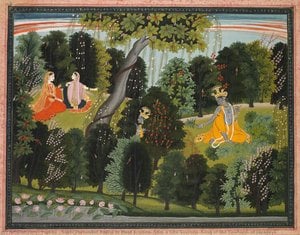
Purkhu’s paintings frequently depict scenes from Hindu mythology, particularly those relating to the Gita Govinda, a celebrated work of Sanskrit poetry exploring the love between Krishna and Radha. His depictions are known for their emotional depth and intricate detail.
- Divine Romance: Scenes portraying the relationship between Krishna and Radha are central to his oeuvre.
- Ragamala Series: He created paintings illustrating the Ragamala, a series depicting musical modes through visual metaphors.
- Narrative Depth: The inclusion of verses and inscriptions adds layers of meaning to his compositions, enriching their narrative power.
Sakhi Persuades Radha to Meet Krishna (from Gita Govinda) is a particularly notable example of his work, showcasing his mastery of color, composition, and storytelling.
Historical Significance and Legacy
Purkhu’s contributions to the Rajput painting tradition are significant. He represents a continuation of artistic excellence within this regional style, demonstrating its enduring vitality during a period of political and cultural change. His work offers valuable insights into the religious beliefs, social customs, and aesthetic preferences of 18th and 19th century India.
Today, Purkhu’s paintings are held in esteemed collections worldwide, including the Memorial Art Gallery of the University of Rochester. Reproductions of his artwork are readily available through platforms like WahooArt.com, allowing a wider audience to appreciate his artistic legacy.
Availability of Reproductions
WahooArt.com offers high-quality reproductions of Purkhu’s work in various formats, including prints on canvas and giclée prints. This accessibility ensures that art lovers can enjoy a piece of Indian artistic history within their own homes or offices.