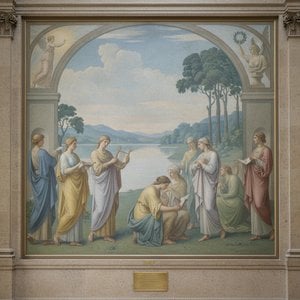
A Life of Scenic Design and Painting
Philippe Chaperon was a French painter and scenic designer who achieved significant fame through his work at the Paris Opera. His career was marked by creating stage designs for numerous 19th-century opera premieres, including works such as Verdi's Don Carlos and Aida, Massenet's Le Cid, Saint-Saëns's Henri VIII, Berlioz's Les Troyens (part two), and the first French performances of Verdi's Otello and Rigoletto, as well as Wagner's Tannhäuser.
Educated at the École des Beaux-Arts, Chaperon studied painting and architecture. His early paintings included Ruines d'un Temple dans l'Inde, which debuted at the Paris Salon of 1844, alongside landscapes of villages, cities, and church interiors. He also worked on decorative paintings and interior designs for private mansions, churches, and public buildings.
The Atelier and Theatre Contributions
Chaperon studied scenic design under Charles Cicéri and Domenico Ferri. In 1864, he formed the atelier "Rubé et Chaperon" with Auguste Alfred Rubé, producing set designs and theatre decor throughout France and Belgium for thirty years. Notable contributions include:
- The trompe-l'œil curtain for the Palais Garnier in 1875.
- The painting on the dome over the main auditorium of La Monnaie.
- A trompe-l'œil curtain for the Éden-Théâtre.
Later, alongside his son Émile, he continued producing designs for productions such as La favorite, Les Huguenots, Frédégonde, Hamlet, and Messidor. His work also extended to the Exposition Universelle in 1900 and the Municipal Casino in Biarritz.
Q&A
Philippe Chaperon은(는) 어느 시대의 작품을 남겼나요?
Philippe Chaperon은(는) 19th Century 시대에 활동했습니다. 이 시기는 역사적 맥락 속에서 작가의 예술적 위치를 보여줍니다.
특정 색상 팔레트의 Philippe Chaperon 작품은 어디에서 찾아볼 수 있나요?
컬러 팔레트별로 보기 페이지에서는 Philippe Chaperon의 작품들을 색상 팔레트별로 모아볼 수 있습니다.
Philippe Chaperon의 출생지와 출생 연도는 어떻게 되나요?
Philippe Chaperon은(는) 1823년 former 2nd arrondissement of Paris에서 태어났습니다.
Philippe Chaperon의 작품을 분위기별로 모아둔 곳은 어디인가요?
아티스트의 무드 룸 페이지에서는 Philippe Chaperon의 작품들을 분위기에 따라 큐레이션된 형태로 만나보실 수 있습니다.