The Foundations of a Vision
Born into a family of Armenian refugees from Kars, Petros Malayan arrived in the world in Yerevan on January 4, 1927. His early years were shaped by the movement of his people, yet his path led him toward the rigorous academic traditions of the great art centers of the Soviet era. After completing his studies at the Baku Art School in 1945, he sought the disciplined instruction found within the Leningrad Art Academy. There, between 1945 and 1947, he studied under masters such as B. Fogel, L. Ostrov, and L. Ovsiannikov, absorbing the technical precision required of a true draftsman.
His education was never finished with the borders of Russia. He eventually moved to the Yerevan State Institute of Fine Arts, where he graduated in 1951 with a Diploma of Excellence. This period of intense study instilled in him a belief that creativity could only truly flourish once an artist had mastered the fundamental laws of nature, light, and shape. To Malayan, the ability to paint was rooted in a firm understanding of geometry and plastic anatomy. He approached the canvas with the discipline of a musician learning their scales, ensuring that every stroke was supported by a structural truth.
A Life of Color and Instruction
Malayan’s career was defined by a dual devotion to the brush and the classroom. For decades, he shared his knowledge as a teacher of drawing, eventually ascending to the position of Professor and Chair of Drawing at the Yerevan Art Institute of Armenia in 1990. He watched three generations of students pass through his hands, passing on his conviction that self-discipline was the precursor to true expression. His influence extended beyond the classroom through his role in the Soviet Artist Association's Commission on Watercolor, where he represented the Armenian tradition since 1970.
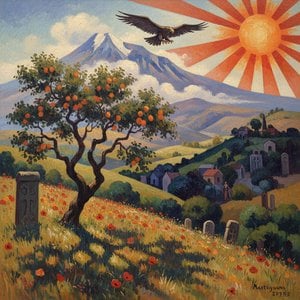
His work often moved between the structured world of Socialist Realism and the more fluid, emotional realm of Expressionism. In his paintings, one might see a certain looseness, particularly in his still lifes. He did not always seek to be precise or fussy; instead, he allowed colors to push against one another, creating a sense of movement. In works like Still Life with Fruits, the paint appears watery and juicy, with brushstrokes that create halos around objects, making fruit seem to radiate its own light. This approach captured the essence of his subjects through texture and color rather than mere photographic imitation.
A Legacy Across Borders
The reach of Malayan’s art was far wider than the Armenian Republic. His paintings traveled to diverse corners of the globe, finding audiences in the United States, Canada, Cuba, Belgium, and Egypt, as well as across Europe in nations like Poland, Austria, and Czechoslovakia. He also held personal exhibitions in Bulgaria and Russia, leaving a mark on the international stage through both his graphics and his paintings. His recognition within his homeland was significant, earning him the title of Honored Artist of the Armenian Republic in 1983.
The final chapter of his life took him far from the familiar streets of Yerevan. In 1993, following a long illness and the difficulty of accessing necessary medical care, he and his family moved to Tel Aviv, Israel. Even as his health declined, he remained tethered to his craft, working until his death from a stroke on March 17, 1997. He remains buried in the Kibbutz Einat cemetery, leaving behind a body of work that resides in various museums and private collections throughout Europe, preserving the spirit of an artist who sought the truth in both form and feeling.
Q&A
Petros Malayan의 출생지와 출생 연도는 어떻게 되나요?
Petros Malayan은(는) 1927년 Baku에서 태어났습니다.
Petros Malayan의 작품 중 조회수가 가장 높은 것은 무엇인가요?
Petros Malayan 작가의 작품 통계 정보는 방문 통계 페이지에서 확인하실 수 있습니다.
특정 색상 팔레트의 Petros Malayan 작품은 어디에서 찾아볼 수 있나요?
컬러 팔레트별로 보기 페이지에서는 Petros Malayan의 작품들을 색상 팔레트별로 모아볼 수 있습니다.
Petros Malayan의 출생 도시와 국가는 어디인가요?
Petros Malayan은(는) Azerbaijan Baku에서 태어났습니다.