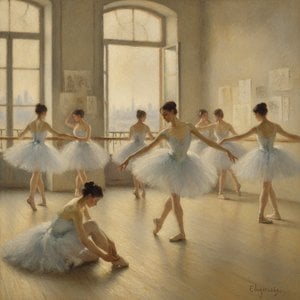
The Gentle Soul of French Genre Painting
Born in the vibrant city of Bordeaux on February 12, 1826, Paul Seignac emerged as a master of capturing the quiet, poignant moments of nineteenth-century life. His journey from the southwest of France to the heart of the Parisian art world was marked by a profound dedication to the beauty found in the ordinary. After moving to Paris to pursue his artistic calling, he immersed himself in the rigorous traditions of the Ecole des Beaux-Arts, studying under the guidance of Theodore Duverger and the esteemed history painter Edouard Picot. This formal training provided him with a technical foundation that would later allow him to breathe life into the most delicate subjects, transforming simple rural scenes into enduring windows of nostalgia.
Seignac’s artistic evolution was defined by a move away from the grandiosity of historical narratives toward the intimate charm of genre painting. He found his true voice in the depiction of children and the pastoral rhythms of country life. His canvases often serve as tender evocations of innocence, where sunlight filters through rustic interiors or illuminates the playful faces of youth amidst the landscape. Through a masterful command of light and texture, he was able to convey not just a visual scene, but an emotional atmosphere—a sense of peace and timelessness that resonated deeply with the sensibilities of his era.
A Legacy of Light and Tenderness
The success of Seignac’s work was not confined to the borders of France; his reputation blossomed internationally, earning him acclaim from critics in England and the United States. His talent was recognized by the prestigious Paris Salon, where he made his debut in 1849, and his lifelong commitment to excellence was honored with an official mention at the 1889 exhibition. The New York Times even offered praise for his remarkable ability to capture human emotion, cementing his status as a globally recognized figure of his time.
Beyond the fame of the salons, Seignac’s significance lies in his contribution to the social meaning of art during the late nineteenth century. By choosing to paint the real lives of ordinary people—the laborers, the children, and the rural folk—he participated in a movement that sought to make fine art accessible and relatable to all classes of society. His works remain preserved in significant collections, including museums in Ajaccio, Corsica, and Reims, serving as a testament to a life spent celebrating the quiet dignity of the human experience. Even today, his paintings continue to captivate collectors, offering a soulful retreat into a world of warmth, light, and enduring grace.
Q&A
Paul Seignac 작가의 작품을 감상할 수 있는 3D 갤러리는 어디인가요?
Paul Seignac의 작품은 작가의 3D 갤러리 페이지 내 3D 갤러리에서 감상하실 수 있습니다.
Paul Seignac의 전 작품에 걸친 색채 활용을 살펴볼 수 있을까요?
이 사이트에 등록된 작품 전반에 나타나는 Paul Seignac의 색채 활용은 작가의 팔레트 지놈 페이지에서 자세히 살펴보실 수 있습니다.
특정 매체로 분류된 Paul Seignac의 모든 작품을 어떻게 찾을 수 있나요?
모든 매체별 페이지에서는 Paul Seignac의 작품을 기법별로 모아볼 수 있습니다.
Paul Seignac의 작품 전체 목록을 볼 수 있는 곳이 있나요?
이 사이트에 등록된 Paul Seignac의 모든 작품은 작가의 전체 작품 보기 페이지에서 만나보실 수 있습니다.