The Decorative Hand of Norway
Born in the rural landscape of Hedemark, Romedal, Paul Ansteinsson began his professional life far from the grand galleries of Europe. His early years were spent as a paintmaker in Hamar, a practical beginning that grounded his understanding of color and medium before he ever touched a brush for fine art. This technical foundation proved essential as he moved toward formal study, first in Kristiania and later in the artistic hubs of Paris and Düsseldorf. It was during these formative years in Europe that he mastered the demanding techniques of fresco and secco, skills that would define his professional identity upon his return to Norway.
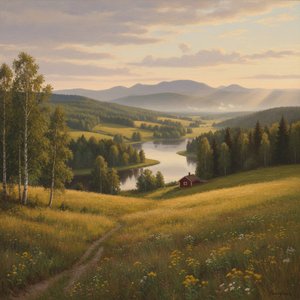
Ansteinsson was a man of many disciplines, moving between the roles of painter, graphic artist, and craftsman. While he produced realistic landscapes of Setesdal, Vestlandet, and Nordland, his most significant contributions were found on the walls of public and commercial spaces. He possessed a rare ability to transform architecture through decoration, often blending exotic motifs of flora and fauna to create immersive environments. His work was not confined to the canvas; he applied his vision to textiles, embroidery, and even painted serving trays, demonstrating a versatility that bridged the gap between fine art and functional design.
A Legacy in Color and Space
His reputation was built largely through large-scale commissions that required both technical precision and a vivid imagination. He became a central figure in the decorative landscape of Oslo, contributing to the visual identity of several significant buildings. His work was characterized by a romantic sensibility, often drawing from biblical themes, folklore, and myth to populate his compositions. This imaginative approach allowed him to navigate diverse styles, from the structured requirements of architectural decoration to the more fluid expressions of his oil and watercolor studies.
The scope of his influence extended into the burgeoning culture of cinema. In Norway, he earned the moniker kinomaleren due to his extensive work decorating movie theaters across the country. His decorative schemes for spaces such as the Mauriske hall at Hotel Bristol and various cinemas in Ålesund and Larvik showcased a talent for creating atmosphere through large-scale mural work. Even as he taught at the Statens Håndverks- og Kunstindustriskole in the 1930s, his practice remained rooted in this intersection of art and the built environment.
Q&A
Paul Ansteinsson의 작품을 분위기별로 모아둔 곳은 어디인가요?
Paul Ansteinsson의 무드 룸에서는 작가의 작품들을 분위기별로 만나보실 수 있습니다.
Paul Ansteinsson의 출생 도시와 국가는 어디인가요?
Paul Ansteinsson은(는) Norway Romedal에서 태어났습니다.
Paul Ansteinsson 작가의 작품을 감상할 수 있는 3D 가상 투어가 있나요?
Paul Ansteinsson의 작품은 작가의 3D 갤러리 페이지 내 3D 갤러리에서 감상하실 수 있습니다.
Paul Ansteinsson의 작품 중 몇 점을 둘러보실 수 있나요?
전체 작품 보기 페이지에서 Paul Ansteinsson의 작품 작품 7점점을 만나보실 수 있습니다.