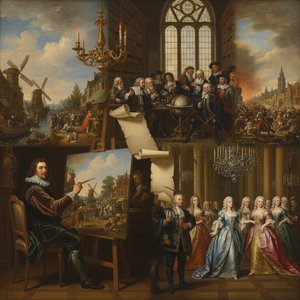
Early Life and Artistic Training
Born on May 16, 1850, in Elberfeld, Otto Kirberg entered a world that would eventually shape his perspective as a painter. His early years in Germany provided the foundation for a life dedicated to the canvas. At the age of 19, he sought formal instruction by enrolling at the Kunstakademie Düsseldorf. This institution was a significant place for his development, offering him the technical grounding necessary to pursue a career in art.
During his time at the academy, Otto Kirberg studied under the guidance of Oswald Achenbach. His training was further refined in the atelier of Wilhelm Sohn, located in the "Wunderbau" on Pempelforter Straße. These mentors provided him with the discipline and skill required for the genre painting he would later pursue. However, his path was not without interruption. The realities of the era meant that his studies were put on hold when he left to participate in the Franco-Prussian War.
After the conflict, he returned to his artistic pursuits, eventually leaving Sohn's atelier in 1879. This period of his life marked a transition from a student following the lead of established masters to an artist beginning to find his own way through the world. His early training in Düsseldorf remained the bedrock of his technical ability, even as his interests began to shift toward the lives and landscapes he would encounter in later years.
Studies in the Netherlands and Genre Painting
In 1879, Kirberg left the atelier of Wilhelm Sohn to seek a different kind of inspiration. This decision led him on a long study trip through the Netherlands, where the landscape and the people began to shape his artistic direction. He spent significant time in various Dutch coastal towns, finding himself drawn to the atmosphere of the sea and the lives lived alongside it.
These coastal stays changed the way he approached his subjects. He became increasingly interested in genre painting, moving toward scenes that captured the quiet, often difficult realities of the people living by the water. He focused his attention on the simple and impoverished lives of these coastal inhabitants, seeking to portray their daily struggles with honesty. Alongside these human stories, he also painted atmospheric coastal landscapes that reflected the mood of the North Sea environment.
Major Works and Recognition
In 1876, Kirberg produced Das Opfer der See, a work that would define much of his early professional standing. This painting caught the attention of the Nationalgalerie Berlin, which added the piece to its collection. The recognition did not stop with the acquisition; during an exhibition the following year, the work was awarded a gold medal.
His output continued steadily through the late 1870s and early 1880s. In 1879, he exhibited Musikalische Unterbrechung, followed by the creation of Sorgenvolle Stunden in 1880. These pieces reflected his ongoing interest in the quiet, often difficult realities of coastal life. By 1883, he had completed Holländische Kirmesszene, further establishing his presence in the genre of painting.
Q&A
Otto Kirberg의 작품을 팔레트별로 모아둔 곳은 어디인가요?
특정 색상 팔레트의 Otto Kirberg 작품을 찾으시려면, 작가의 컬러 팔레트별로 보기 페이지를 이용해 보세요.
Otto Kirberg의 작품 중 조회수가 가장 높은 것은 무엇인가요?
Otto Kirberg 작가의 작품 통계 정보는 방문 통계 페이지에서 확인하실 수 있습니다.
Otto Kirberg의 출생지와 출생 연도는 어떻게 되나요?
Otto Kirberg은(는) 1850년 Elberfeld에서 태어났습니다.
Otto Kirberg의 예술 세계는 시간이 흐름에 따라 어떻게 진화했나요?
Otto Kirberg의 예술적 여정은 연대기 페이지에서 시기별로 펼쳐집니다. 이곳에서는 작가의 활동 시기를 장(chapter)으로 나누어 작품들을 연대순 타임라인 형태로 한눈에 확인할 수 있습니다.