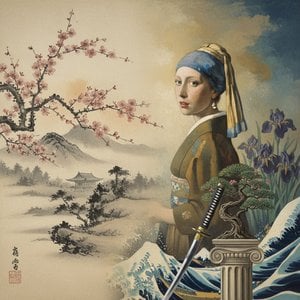
The Ink-Stained Legacy of Nakabayashi Chikutō
In the quiet, contemplative atmosphere of Edo-period Japan, a profound artistic dialogue was unfolding between the traditions of China and the burgeoning sensibilities of the Japanese literati. At the heart of this movement stood Nakabayashi Chかったです (1776–1853), a master of the Nanga style whose brushstrokes served as a bridge between eras. Born Nariaki in Nagoya to a family of physicians, Chikutō’s early life was marked by an innate fascination with the expressive potential of ink and wash. His journey was not merely one of solitary practice but was deeply intertwined with a network of scholars and artists who sought to capture the spiritual essence of nature through the lens of classical Chinese aesthetics.
The trajectory of Chikutō’s development was irrevocably altered by early mentorship and profound friendships. At the tender age of fourteen, he formed a lifelong bond with the artist Yamamoto Baiitsu, a partnership that would become one of the most significant collaborations in Japanese art history. Their shared education was nurtured under the watchful eye of Kamiya Ten’yū, a wealthy merchant and connoisseur whose vast collection of calligraphy and paintings served as Chikutō’s first true classroom. By meticulously copying the treasures within Kamiya’s collection, Chikutō began to internalize the rhythmic complexities and tonal subtleties of the masters, laying the foundation for a style that would eventually resonate far beyond his native Nagoya.
Echoes of the Yuan Dynasty
Chikutō’s artistic soul was deeply rooted in the reverence for the Yuan Dynasty landscapes of China. He found particular inspiration in the works of Ni Zan, whose minimalist elegance and evocative use of space profoundly shaped Chikutō’s approach to composition. This influence is visible in his ability to utilize subtle tonal gradations and masterful brushwork to create atmospheres that feel both physically present and spiritually distant. His landscapes are not mere depictions of terrain; they are meditations on the permanence of nature and the fleetingness of human existence, characterized by a graphic elegance and a rhythmic arrangement of forms.
As his technique matured, Chikutō’s work began to exhibit a unique decorative quality that balanced scholarly restraint with visual impact. Whether capturing the stark, frozen beauty of Herons in the Snow or the serene atmosphere of Sampling Tea beneath the Wu Trees, he possessed an uncanny ability to use contrast—the deep blacks of ink against the pristine white of paper—to direct the viewer's emotional response. This mastery of light and shadow, achieved through horizontal washes and precise line work, allowed him to breathe life into the inanimate, turning a simple branch or a distant mountain peak into a vessel for poetic thought.
A Literary and Scholarly Life
The significance of Nakabayashi Chikutō extends beyond the canvas and into the realm of literary scholarship. Following the death of his mentor, Chikutō relocated to Kyoto, a move that placed him at the epicenter of Japan's intellectual renaissance. Here, he became an integral member of elite literary circles, associating with figures such as the philosopher Rai San’yō and the artist Uragami Shunkin. This immersion in classical literature and philosophy infused his painting with a profound intellectual depth, ensuring that every stroke was imbued with meaning derived from ancient verse and historical wisdom.
His contributions to the pedagogical foundations of the Nanga style were cemented through several significant publications and theoretical works:
- Gadō kongōsho: An illustrated treatise on painting produced in collaboration with Uragami Shunkin, which served to codify the techniques of the era.
- Chikutō garon: A personal exploration of his painting philosophy, reflecting his deep connection to the literati ideals.
- Chikutō gakyō: A collection of sketches that showcased his raw, observational talent and preparatory brilliance.
Ultimately, Chikutō’s legacy is one of continuity and refinement. Through his lineage—including his son Chikkei and daughter Kiyomi—and his enduring influence on the Nanga tradition, he ensured that the delicate balance of Chinese-inspired landscape painting and Japanese aesthetic sensitivity would endure. His works, now preserved in prestigious institutions such as the Denver Art Museum and the Metropolitan Museum of Art, remain timeless testaments to a life dedicated to the pursuit of beauty through the disciplined application of ink.
질의응답
Nakabayashi Chikutō 작가는 어떤 색상을 가장 자주 사용했나요?
Nakabayashi Chikutō 작가 작품의 컬러 프로필은 작가의 팔레트 지놈 페이지에서 확인하실 수 있습니다.
Nakabayashi Chikutō 작가 작품에 대한 통계 정보는 어디에서 확인할 수 있나요?
Nakabayashi Chikutō의 작품에 관한 통계를 보여주는 통계 페이지가 본 웹사이트에 마련되어 있습니다.
Nakabayashi Chikutō의 작품을 색상 스펙트럼별로 살펴볼 수 있나요?
Nakabayashi Chikutō의 작품은 작가의 색상별 인덱스 페이지에서 색상별로 살펴보실 수 있습니다.