The Soul of the Literati: The Life and Legacy of Morikawa Kyoriku
Morikawa Kyoriku, also known by his name Kyoroku, remains a luminous figure in the tapestry of Japanese art history, embodying the profound intersection of poetry, calligraphy, and painting. Born in Edo in 1656, Kyoriku emerged during a transformative era in Japan, carving out a niche within the literati school of painting. This movement was not merely about technical prowess but was deeply rooted in the expression of personal sentiment, intellectual depth, and the spontaneous flow of the artist's inner spirit. As a scholar-artist, his life was dedicated to the pursuit of beauty through the refined disciplines of the brush, leaving behind a legacy that bridged the gap between the rigid traditions of the past and the expressive freedom of the literati ideal.Artistic Mastery and the Calligraphic Brush
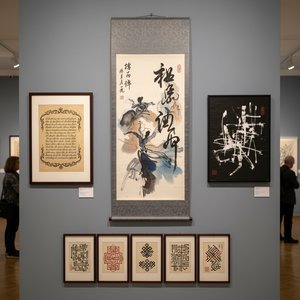
The essence of Kyoriku’s artistry lies in his ability to meld different forms of expression into a singular, cohesive voice. His work is most celebrated for its mastery of calligraphy and its integration with landscape and figure painting. In his notable works, such as the hanging scroll Passage from “A Modern-Day Wen Xuan: Selections of Refined Literature”, one can witness the rhythmic dance of his brush. He utilized a highly cursive, somewhat idiosyncratic style that remained eminently legible, a feat that required immense control over the flow of ink. By punctuating his compositions with an admixture of kana (Japanese phonetic writing) and kanji (Chinese characters), he created a visual texture that was both dense and airy, mirroring the complexities of the poetic themes he explored. His paintings often depicted scholars and literati nestled within natural settings, a hallmark of the literati style which sought to capture the harmony between humanity and the wild, untamed world. Through the use of monochromatic ink, Kyoriku emphasized the subtle gradations of light and shadow, allowing the viewer to feel the atmosphere of the landscape rather than simply observe its physical details. This focus on personal expression and the emotional resonance of the brushstroke set him apart from more decorative or rigid traditional Japanese painting styles of his time.Influences and Historical Significance
Kyoriku’s artistic development was deeply influenced by the broader cultural currents of the Edo period, particularly the influence of Chinese literati painting and the profound impact of Japanese poetic traditions. His close friendship with the renowned artist Hishikawa Moronobu further solidified his position within the influential artistic circles of Japan. Beyond the visual arts, Kyoriku was a significant figure in the world of haikai (seventeen-syllable verse), recognized as one of the top pupils of the legendary master Matsu Bashō. This deep connection to poetry allowed him to infuse his visual works with literary depth, making his art a profound commentary on the very nature of Japanese culture and the "way of poetry." The historical significance of Morikawa Kyoriku extends far beyond his own lifetime. His emphasis on the fusion of calligraphy, painting, and poetry served as a foundation for future generations of artists. Notable figures such as Tomioka Tessai drew inspiration from the stylistic innovations and expressive freedom pioneered by Kyoriku. Today, his work stands as a testament to an era where the artist was not just a craftsman, but a philosopher and poet, using the ink and brush to capture the fleeting beauty of existence and the enduring strength of the human spirit.Q&A
Morikawa Sobun 작가 작품의 컬러 프로필은 어디에서 확인할 수 있나요?
이 사이트에 등록된 작품 전반에 나타나는 Morikawa Sobun의 색채 활용은 작가의 팔레트 지놈 페이지에서 자세히 살펴보실 수 있습니다.
키워드별로 분류된 Morikawa Sobun의 작품은 어디에서 볼 수 있나요?
Morikawa Sobun의 키워드별 탐색 페이지에서는 작가의 작품들을 키워드별로 모아볼 수 있습니다.
Morikawa Sobun 작가의 작품을 감상할 수 있는 가상 박물관에 방문할 수 있나요?
가상 방문이 가능합니다: Morikawa Sobun의 3D 갤러리 페이지에서 3D 갤러리를 통해 작가의 작품들을 만나보실 수 있습니다.
Morikawa Sobun 작가의 다른 활동명이나 알려진 이름이 있나요?
Morikawa Sobun은(는) 森川曽文라는 이름으로도 활동하고 있습니다.