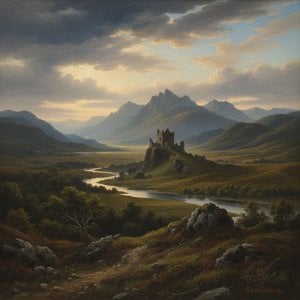
A Visionary of Light and Atmosphere
The art of Michael Andrews (1928–1995) exists in a delicate space between the tangible world and the ethereal realm of thought. A British painter of profound technical mastery, Andrews possessed a rare ability to infuse landscapes and social scenes with a sense of psychological depth and luminous energy. Born in Norwich, England, his early artistic sensibilities were nurtured within the halls of the Norwich School of Fine Art, where a natural talent began to coalesce into a sophisticated modernist vision. His formative years were defined by an engagement with the dynamic rhythms of Vorticism, which he would later soften with a lyrical, almost dreamlike approach to the natural world.
His education at the Slade School of Fine Art served as a crucible for his development, placing him alongside legendary figures such as Lucian Freud and William Coldstream. This period of intense study under masters like Lawrence Gowing and William Townsend provided him with a rigorous foundation in draughtsmanship and observation. However, it was perhaps his time spent in Egypt during his National Service that truly expanded his chromatic palette, introducing him to the vibrant textures and searing light of the desert—elements that would forever haunt the periphery of his compositions.
The Symbology of the Self and the City
As Andrews’ career progressed, his work moved away from the immediate social observations of London's nightlife toward more profound, symbolic explorations. He became deeply fascinated by the concept of the "skin-encapsulated ego," a psychological notion that found its visual manifestation in his celebrated Lights series. In these works, created between 1970 and 1974, Andrews utilized the motif of a balloon drifting through urban landscapes to represent the fragile, floating nature of human consciousness. Inspired by the Symbolist poetry of Arthur Rimbaud, specifically Les Illuminations, these paintings sought to capture a state of enlightenment and an objective, unselfconscious vision of the world.
The imagery within this series is both haunting and beautiful, often featuring balloons suspended over neon-lit streets or amidst vast, atmospheric vistas. This period of his work demonstrates a remarkable synthesis of realism and fantasy, where the boundaries between the physical environment—such as the bright lights of Toronto or the rural stretches of Gloucestershire—and the internal landscape of the mind begin to dissolve. His ability to manipulate light, making it appear both as a source of external illumination and an internal spiritual glow, remains one of his most enduring legacies.
Legacy and Artistic Significance
Throughout his decades-long career, Andrews remained a figure of immense respect among his peers, moving through various artistic circles including the Norwich Twenty Group and teaching at prestigious institutions like the Slade and Chelsea Schools of Art. His versatility allowed him to navigate diverse subject matters, from formal portraiture and intimate depictions of social gatherings to expansive, surrealist landscapes featuring tropical fish or the iconic Ayers Rock in Australia.
The historical significance of Michael Andrews lies in his refusal to be tethered to a single movement. Instead, he created a personal visual language that bridged the gap between the structured discipline of postwar British realism and a more fluid, emotive modernism. His contributions are preserved in some of the world's most esteemed collections, including the Tate Gallery, ensuring that his unique exploration of light, memory, and the human spirit continues to resonate with viewers long after his passing.
Q&A
Michael Andrews의 작품을 색상별로 정렬해서 볼 수 있나요?
Michael Andrews의 작품은 작가의 컬러 인덱스 페이지에서 색상별로 감상하실 수 있습니다.
Michael Andrews 작가의 작품에서 가장 자주 나타나는 색상은 무엇인가요?
이 사이트에 등록된 작품 전반에 나타나는 Michael Andrews의 색채 활용은 작가의 팔레트 지놈 페이지에서 자세히 살펴보실 수 있습니다.
Michael Andrews 작가의 작품을 감상할 수 있는 가상 박물관에 방문할 수 있나요?
Michael Andrews의 3D 갤러리는 작가의 작품들을 가상 3D 갤러리로 감상할 수 있는 페이지입니다.