A Tapestry of Shropshire and Spirit: The Dual Legacy of Mary Webb
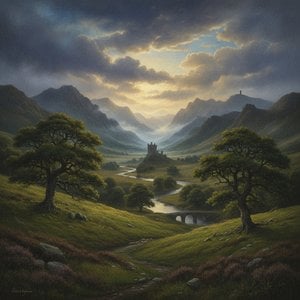
Mary Webb stands as a singular figure in the British cultural landscape, a creator whose soul was inextricably bound to the rolling hills and ancient woodlands of Shropshire. To speak of Webb is to evoke a sense of profound connection between the written word and the visual essence of the English countryside. While history primarily remembers her as a novelist of immense lyrical power, there exists within her legacy a fascinating, more abstract dimension—an artistic pursuit that sought to translate the rhythms of nature into the language of colour and geometry. Her life, though tragically short, was a vibrant exploration of both the tangible beauty of the rural heartland and the intangible mysteries of folklore and mysticism.
Born Mary Gladys Meredith in 1881 at Leighton Lodge, her formative years were steeped in the traditions of the Shropshire landscape. The undulating terrain and deep-rooted local legends provided a rich, sensory foundation for her creative development. Her father, a private schoolteacher with a profound love for literature, nurtured her intellectual curiosity, while the natural world served as her primary instructor. This early immersion in the textures of the earth—the scent of damp soil, the shifting light through ancient canopies, and the whispered legends of the hills—would later manifest in a prose style that was both hauntingly realistic and deeply symbolic.
The Lyrical Voice: Literature as Landscape
Webb’s literary ascent began with a sudden and brilliant flash of recognition. The publication of Gone to Earth in 1903 catapulted her into the forefront of English letters, establishing her as a master of rural fiction. In this work, she did not merely describe the Shropshire countryside; she breathed life into it, treating the landscape as a living, breathing character capable of both tenderness and terror. Her ability to blend psychological depth with an almost supernatural atmosphere allowed her to capture the essence of a vanishing way of life, making her stories resonate far beyond the borders of her home county.
This mastery reached its zenith with Precious Bane in 1924, a novel that remains a cornerstone of her bibliography. Through this work, Webb explored the heavy themes of social injustice and the enduring, often painful, power of folklore. The narrative, marked by its profound empathy for the marginalized, utilized the physical disfigurements of her characters as metaphors for the internal struggles of the human spirit. Her writing was never merely about the pastoral; it was an investigation into the resilience of the soul amidst the harsh realities of rural existence, a theme that would define her historical significance in the canon of early 20th-century literature.
The Geometry of Colour: An Abstract Pursuit
Beyond the boundaries of the printed page, Webb’s creative spirit ventured into the realm of the visual, seeking a different kind of truth through abstraction. Following the upheaval of World War I, her artistic journey began to take shape, influenced by the burgeoning modernist movements that were reshaping the European consciousness. She found herself drawn to the exploration of colour theory and the structural possibilities of form, moving away from representational landscapes toward a more rhythmic, geometric language.
Her visual explorations were characterized by:
- The use of vibrant squares and rectangles to create a sense of structured movement.
- An engagement with colour theory reminiscent of the principles explored by Delaunay, where light and hue dictate the emotional weight of the piece.
- A pursuit of abstraction that sought to capture the underlying energy of the natural world rather than its literal appearance.
This intersection of the literary and the visual—the ability to see both the narrative depth in a landscape and the geometric essence in a splash of colour—marks Webb as a true pioneer. Though her artistic explorations were largely unrecognized during her lifetime, they represent a courageous attempt to bridge the gap between the romanticism of her prose and the radical modernity of the early 20th century. Today, she is celebrated not just as a chronicler of Shropshire, but as an artist who dared to find the universal patterns of existence within the simplest of shapes.