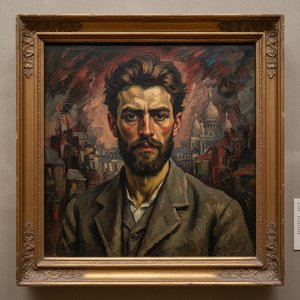
The Life and Evolution of Marc Sterling
Born in Minsk, Belarus, Marc Sterling was a painter and draftsperson who studied in Odessa before attending the Vkhutemas in Moscow during the early 1920s. After a period in Berlin, he established himself in Paris in 1923, becoming part of the international circle of artists known as the École de Paris. His life was marked by significant shifts, including a period of internment in a camp in September 1941 during the Second World War. Following the war, he returned to Paris and later lived between Paris and Switzerland, traveling extensively and exhibiting regularly in galleries and salons until his death in Neuilly-sur-Seine.
Artistic Style and Techniques
Sterling’s body of work is characterized by a continuous renewal of style and technique, utilizing oil, gouache, drawing, wash, and engraving. His artistic journey began with constructivism as a student of Vladimir Tatline, later evolving toward synthetic cubism through contact with artists such as Pablo Picasso, Georges Braque, Juan Gris, and Jean Metzinger. During the 1930s, his work transitioned into a lyrical realism, often depicting flower bouquets, birdcages, and portraits of his daughters. While his post-war period included dark, tragic visions, his later years in the 1950s moved toward subjects of calm and delicacy, such as nudes and portraits. His final period, spanning the 1960s and 1970s, embraced greater freedom in color and subject matter, featuring:
Q&A
Marc Sterling의 작품을 분위기별로 모아둔 곳은 어디인가요?
아티스트의 무드 룸 페이지에서는 Marc Sterling의 작품들을 분위기에 따라 큐레이션된 형태로 만나보실 수 있습니다.
미술 사조별로 분류된 Marc Sterling의 작품은 어디에서 볼 수 있나요?
Marc Sterling의 작품은 작가의 모든 미술 사조 페이지에서 사조별로 만나보실 수 있습니다.
주제별로 Marc Sterling의 작품을 찾아볼 수 있나요?
Marc Sterling의 주제별 작품 모음는 작가의 작품들을 주제별로 찾아볼 수 있는 페이지입니다.
Marc Sterling의 작품을 매체별로 찾아볼 수 있나요?
Marc Sterling의 작품은 작가 페이지인 모든 매체별에서 매체별로 둘러보실 수 있습니다.