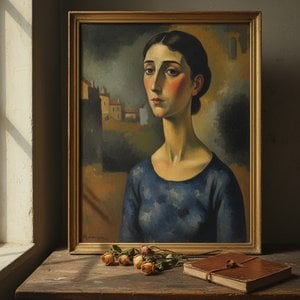
Manlio Rho (1901–1957): Pioneer of Italian Abstract Expressionism
Manlio Rho (1901 – 1957) stands as one of the most influential figures in Italian abstract art, a pivotal voice during the formative years of the avant-garde movement that reshaped European artistic sensibilities. Born in Como, Italy, Rho’s journey began with figurative painting but swiftly embraced the radical experimentation championed by Wassily Kandinsky and Kazimir Malevich – movements that profoundly impacted Como's artistic landscape and cemented Rho’s place within the Astrattisti Comaschi group. This collective, alongside architects Giuseppe Terragni and Alberto Sartoris, represented a watershed moment in Italian art history, establishing a dialogue with international trends and propelling Rho to prominence as a leader of his time.- Early Influences & Formation: Rho’s initial artistic explorations were rooted in traditional techniques, absorbing stylistic cues from Impressionism and Futurism. However, the burgeoning abstract movement captivated him, particularly Kandinsky's exploration of color and form as expressive vehicles.
- The Astrattisti Comaschi & Geometric Synthesis: Joining forces with fellow artists like Aldo Galli, Carla Prina, and Carla Badiali, Rho spearheaded the Astrattisti Comaschi group—a collective dedicated to forging a distinctly Italian path toward abstraction. This collaboration fostered a shared commitment to geometric shapes and chromatic harmony, mirroring the principles of Suprematism while retaining an inherent warmth characteristic of Northern Italian artistic tradition.
- Shift Towards Abstract Composition: Recognizing the transformative potential of pure abstraction, Rho transitioned from figurative representation to geometric explorations in the early 1930s. His canvases became dominated by luminous, lukewarm colors—greens, browns, and oranges—arranged in simple yet powerful forms that conveyed a sense of balance and serenity.
- Futurist Engagement & Artistic Manifestos: Rho’s involvement extended beyond purely visual experimentation; he signed Antonio Sant'Elia’s Futurist Manifesto Futuristi Primordiali, demonstrating his alignment with the movement’s embrace of dynamism and technological advancement.
Notable Exhibitions & Recognition
Rho’s artistic vision gained international acclaim through participation in nine Venice Biennale exhibitions spanning from 1940 to 1986—a testament to his enduring relevance within the broader context of modern art. Furthermore, his works were prominently featured in two monumental retrospectives held at Milan's Royal Palace: Camera con Vista (2007) and Kandinskji e arte astratta italiana (2007), solidifying his legacy as a cornerstone of Italian abstract expressionism. These exhibitions underscored the breadth of Rho’s oeuvre and cemented his reputation as a visionary artist whose influence extended far beyond the confines of Como.- Venice Biennale Appearances: His consistent presence at the Venice Biennale showcased his commitment to artistic dialogue and demonstrated the universality of his aesthetic concerns.
- Royal Palace Exhibitions: The inclusion in Camera con Vista and Kandinskji e arte astratta italiana highlighted Rho’s connection to pivotal movements within European art history, establishing him as a key figure in shaping the visual landscape of the 20th century.
Style & Artistic Characteristics
Rho's distinctive style is characterized by a harmonious fusion of geometric rigor—drawing inspiration from Suprematism—and Northern Italian warmth. His paintings consist of flat geometric shapes bathed in muted hues, creating an atmosphere of contemplative stillness. The careful orchestration of color and form reflects Rho’s profound understanding of visual perception and his ability to convey emotion through abstract forms. This approach distinguishes him from many other artists of his era and contributes to the enduring fascination with his work. Rho's legacy continues to inspire artists today, demonstrating the transformative power of abstraction and its capacity to communicate universal themes of beauty and contemplation.Legacy & Influence
Rho’s contribution to Italian art history is undeniable. His pioneering exploration of geometric abstraction established a precedent for subsequent generations of artists—particularly in Como—who sought to engage with international artistic currents while maintaining a distinctive regional identity. Today, Rho's paintings reside in prominent museums across Italy and internationally, ensuring that his groundbreaking vision remains accessible to audiences worldwide. He remains an exemplar of artistic innovation and a symbol of Como’s vibrant cultural heritage.Q&A
Manlio Rho 작가의 작품을 연도별로 어떻게 확인할 수 있나요?
Manlio Rho의 작품을 연도별로 정리하여 보여주는 작품 연대기 페이지입니다.
Manlio Rho의 작품을 분위기별로 찾아볼 수 있나요?
아티스트의 무드 룸 페이지에서는 Manlio Rho의 작품들을 분위기에 따라 큐레이션된 형태로 만나보실 수 있습니다.
Manlio Rho의 모든 작품을 어디에서 볼 수 있나요?
이 사이트에 등록된 Manlio Rho의 모든 작품은 작가의 전체 작품 보기 페이지에서 만나보실 수 있습니다.