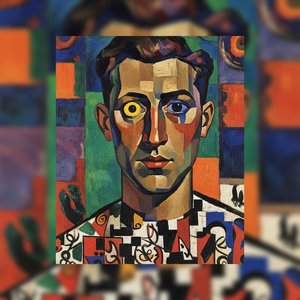
Malcolm Morley: The Architect of Superrealism
Malcolm Morley (1931 – 2018) stands as a pivotal figure in the latter half of the 20th century’s artistic landscape, recognized primarily for establishing Superrealism—a movement that challenged the conventions of Pop Art and championed a meticulous engagement with photographic imagery. Born in London, England, Morley embarked on his artistic journey in earnest during the mid-1960s, initially collaborating with fellow musician Dave Charles to form the blues band Hoodoo Blues Band. This formative experience instilled an appreciation for raw emotion and musical exploration that would permeate his subsequent work.- Early Influences: Morley’s artistic sensibilities were profoundly shaped by encounters with seminal artists like Barnett Newman, Milton Resnik, and Salvador Dali during his time in New York City in 1958. These interactions exposed him to the expansive canvases of Newman—particularly *Virgil Turner*, which championed a minimalist aesthetic—and fueled his fascination with exploring the relationship between abstraction and representation.
- The Genesis of Superrealism: Morley’s breakthrough came in 1968 with Ivan Karp's exhibition at Jill Kornblee Gallery, where he debuted his groundbreaking approach to painting. Rejecting the stylistic trends prevalent at the time—namely Pop Art—Morley devised a method that fused photographic realism with abstract principles. This innovative technique involved meticulously reconstructing images from photographs onto large canvases using a grid system and employing painstaking brushwork to achieve an uncanny level of detail.
Help Yourself & Beyond: Musical Collaborations and Artistic Evolution
Morley’s musical career paralleled his artistic development, culminating in the formation of Help Yourself alongside Dave Charles and Ernie Graham. The band's debut album, recorded in 1970-71 before any performances took place, solidified Morley’s commitment to exploring sonic textures and lyrical narratives simultaneously. Their collaborative spirit extended beyond Help Yourself, notably through involvement with Brinsley Schwarz & Ernie Graham’s management and subsequent collaborations with Jonathan “Jojo” Glemser on Graham's solo project. Performances at Glastonbury Festival in 1970 and 1971 cemented Morley’s reputation as a charismatic performer and solidified his connection to the burgeoning British rock scene.- Notable Collaborations: Help Yourself continued its trajectory with appearances on Peel Sessions and recordings of “Beware Of The Shadow,” showcasing their adaptability and willingness to experiment musically. Furthermore, Morley contributed to Ernie Graham’s debut album in 1971 and backed Leonhard’s iceberg project in 1972, demonstrating his versatility as a musician across diverse genres.
The Superrealist Method & Artistic Vision
Morley's artistic method—characterized by the appropriation of photographic images and their subsequent reconstruction onto expansive canvases—became synonymous with Superrealism. This distinctive style involved dissecting photographs into smaller sections, meticulously transferring them to large canvases using a grid system, and painstakingly rebuilding the image pixel by pixel through painstaking brushwork. He famously referenced Barnett Newman’s *Virgil Turner*, stating that he wished to “fill it up again,” mirroring Newman's ambition to inject space with color and texture. This approach wasn’t merely about replicating visual information; it was a deliberate act of confronting and reimagining the source material, prompting viewers to consider the interplay between perception and representation.Legacy & Recognition
Morley’s influence extended beyond his artistic output, shaping discussions surrounding conceptual art and challenging established notions of stylistic categorization. He garnered international acclaim for his pioneering work in Superrealism, securing the inaugural Turner Prize in 1984—a controversial decision at the time—and earning accolades from institutions like Yale School of Art and The Broad Museum. His enduring contribution to contemporary art is recognized through exhibitions worldwide and celebrated as a testament to artistic innovation and unwavering dedication to exploring the complexities of visual language.Q&A
특정 주제별로 Malcolm Morley의 작품을 어떻게 찾아볼 수 있나요?
특정 주제의 Malcolm Morley 작품을 찾으려면 키워드별로 작품이 분류된 작가의 키워드별 탐색 페이지를 이용해 보세요.
Malcolm Morley 작가의 다른 활동명이나 알려진 이름이 있나요?
Malcolm Morley은(는) مالكوم مورلي, マルコム・モーリー, 맬컴 몰리, Малкольм Морли(으)로도 알려져 있습니다.
Malcolm Morley 작가 작품의 컬러 프로필은 어디에서 확인할 수 있나요?
Malcolm Morley의 팔레트 지놈에서는 작가의 작품 세계를 구성하는 컬러 프로필을 확인하실 수 있습니다.
Malcolm Morley의 모든 작품은 어디에서 볼 수 있나요?
이 사이트에 등록된 Malcolm Morley의 모든 작품은 작가의 전체 작품 보기 페이지에서 만나보실 수 있습니다.