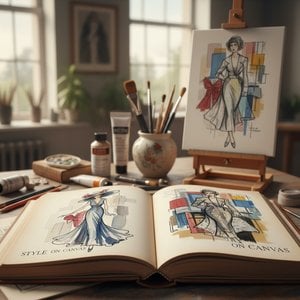
A Parisian Visionary: Main Rousseau Bocher and the Legacy of Timeless Elegance
Main Rousseau Bocher, known to the world simply as Mainbocher, was an American couturier who defied convention to establish himself as a singular voice in the landscape of haute couture. Born in Chicago in 1890 amidst the burgeoning industrialization of the United States, his journey toward Parisian fame began with studies at the Lewis Institute and the Chicago Academy of Fine Arts. This early grounding in artistic principles would subtly inform his distinctive aesthetic, allowing him to approach fabric not merely as material, but as a medium for visual storytelling. His formative years were shaped by the tumultuous era of World War I, during which he served as an intelligence officer, fostering connections within Europe's intellectual circles before relocating permanently to Paris after the conflict’s conclusion.
It was in the heart of Paris that Bocher truly blossomed professionally. Before ever picking up a needle to lead his own house, he gained significant recognition as a fashion illustrator for Harper’s Bazaar and ascended to the prestigious role of Paris Fashion Editor at Vogue between 1922 and 1929. This period immersed him in the vibrant pulse of avant-garde expression, cementing his understanding of cultural trends and visual elegance. In a bold act of entrepreneurship in 1929, he founded Mainbocher Couture, a studio meticulously designed to recreate the intimate atmosphere of his beloved Parisian salons. By merging his first and last names, he created a brand that sounded both sophisticated and quintessentially French, even as he brought an American sensibility to the tightly guarded traditions of French couture.
The Art of Understated Sophistication
Bocher’s success stemmed from an unwavering dedication to tradition blended with a subtle reimagining of established techniques. Unlike many contemporaries who prioritized fleeting, loud fashions, Bocher championed a style characterized by understated sophistication and enduring beauty. He possessed a rare ability to "dress women like ladies," focusing on clean lines, exquisite tailoring, and a sense of effortless grace. His technical innovations were often deceptively simple; he is credited with the creation of the iconic strapless dress and luxurious jeweled cashmere sweaters, pieces that redefined evening wear for the modern woman. By the late 1930s, his forward-thinking approach even led him to introduce cloth evening coats as a refined alternative to heavy furs, foreshadowing the evolution of the modern suit.
The allure of his work lay in its ability to evoke absolute luxury through subtlety. His designs were not merely garments but architectural feats of fabric that celebrated the female form without overwhelming it. This mastery of silhouette ensured that his creations remained timeless, transcending the era in which they were conceived. His influence was felt deeply within the upper echelists of society, as he cultivated a clientele that read like a Who's Who of the twentieth century:
- Aristocrats and Socialites: Including Princess Karam of Kapurthala, the Vicomtesse de Noailles, and the legendary Mrs. Cole Porter.
- Fashion Icons: Renowned editors such as Diana Vreeland, Carmel Snow, and Bettina Ballard.
- Hollywood Royalty: Stars including Mary Pickford, Claudette Colbert, and Irene Dunne.
- Cultural Figures: The celebrated pianist Dame Myra Hess.
A Legacy Written in Blue and Silk
Perhaps no single moment defines the historical significance of Mainbocher more than his collaboration with Wallis Simpson. In 1937, Bocher was selected to design the wedding dress for the woman who would become the Duchess of Windsor. The resulting strapless gown, famously featuring a back detail that remains a subject of study in costume institutes today, became one of the most photographed and copied dresses of modern times. It was during this era that he even bestowed upon the world "Wallis Blue," a color synonymous with his patron's elegance. Though Bocher famously destroyed the pattern for the dress to preserve its exclusivity, its impact on fashion history remains indelible.
As the tides of history shifted with the onset of World War II, Bocher moved his operations from Paris to New York in 1940. While he intended this move to be temporary, he continued to define American luxury until his retirement in 1971. His New York salon remained one of the most exclusive destinations in the world, operating largely through word-of-mouth and personal recommendations rather than overt advertising. Through it all, Mainbocher remained a master of the "subtle luxury" that defines true style—a legacy that continues to inspire designers and historians alike, reminding us that true elegance never truly goes out of fashion.
질의응답
주제별로 분류된 Main Rousseau Bocher의 작품들은 어디에서 확인할 수 있나요?
Main Rousseau Bocher의 주제별 아틀라스는 작가의 작품들을 주제별로 분류하여 보여주는 페이지입니다.
특정 주제에 따른 Main Rousseau Bocher의 작품을 어떻게 찾을 수 있나요?
Main Rousseau Bocher의 키워드별로 페이지에서는 작가의 작품들을 키워드별로 모아볼 수 있습니다.
Main Rousseau Bocher 작가는 어떤 사조에 참여했나요?
Main Rousseau Bocher 작가가 활동했던 예술 사조는 작품을 사조별로 분류하여 보여주는 작가의 모든 사조 페이지에서 확인하실 수 있습니다.