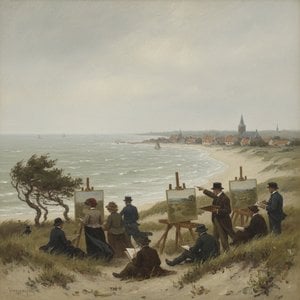
The Silent Symphony of Louis Apol
Lodewijk Frederik Hendrik Apol, known to the world as Louis Apol, was a master of stillness, a painter who found profound beauty in the hushed, frozen moments of the natural world. Born in The Hague in 1850, Apol emerged as a cornerstone figure of the Hague School, an artistic movement that redefined Dutch landscape painting at the turn of the century. While many of his contemporaries sought to capture the drama of sweeping vistas or the energy of human industry, Apol turned his gaze toward the quietude of winter. His oeuvre is characterized by an almost unnerving tranquility—a deliberate rejection of bustling activity in favor of meticulously rendered snowy forests and frost-laden meadows where the only movement is the subtle play of light upon a drift of snow.
Apol’s artistic journey was one shaped by both rigorous classical training and the raw, untamed inspiration of the Arctic. His talent was recognized early by his father, who secured private instruction from esteemed masters such as Johannes Fokkens Hoppenbrouwers and Pieter Frederik Stortenbeker. This foundational period instilled in him a deep respect for tonal harmony and atmospheric perspective. His burgeoning skill did not go unnoticed by the state; in 1868, he was honored with a royal scholarship from King Willem III, which allowed him to pursue formal studies at the Royal Academy of Arts in Amsterdam. It was during these formative years that Apol began to refine the delicate touch required to capture the ephemeral textures of ice and frost.
The Arctic Catalyst and Artistic Vision
A defining moment in Apol’s life, and perhaps the most significant catalyst for his mature style, occurred in 1880. He joined an expedition aboard the SS Willem Barents to the desolate, breathtaking wilderness of Spitsbergen (Nova Zembla) in the Arctic Ocean. This journey into the frozen north served as a profound spiritual and artistic awakening. The stark, monumental beauty of the Arctic—the towering glaciers, the shimmering ice fields, and the vast, desolate expansions of white—became an enduring source of inspiration that would haunt his canvases for decades. Upon his return, his work moved beyond mere representation; he began to imbue his landscapes with a sense of the sublime, capturing the ethereal quality of light as it interacts with frozen terrain.
This fascination with the cold and the quiet led to a highly specialized body of work. Apol’s paintings are often celebrated for their tonalism, using a sophisticated palette of muted greys, soft blues, and brilliant whites to create depth and atmosphere. He frequently incorporated subtle man-made elements—a lonely wooden bridge, a distant fence, or a small stable—to provide scale and a sense of quiet human presence within the vastness of nature. In his most successful works, human figures are seldom the protagonists; instead, they serve as mere accents to the overwhelming majesty of the winter landscape, emphasizing the solitude and peace of the season.
Legacy and Historical Significance
The historical significance of Louis Apol lies in his ability to elevate the winter scene from a seasonal subject to a profound meditation on nature's endurance. His work is widely held in prestigious collections across the globe, including:
- The Rijksmuseum Amsterdam, which holds significant pieces such as Januari-avond in het bosch.
- The Gemeentemuseum Den Haag, reflecting his deep roots in the Dutch tradition.
- International collections spanning the United Kingdom, Germany, Canada, and the United States.
Apol’s legacy is that of a painter who mastered the art of the "silent symphony." He taught viewers to find wonder in the absence of sound and beauty in the stillness of the frost. By focusing on the subtle nuances of light and the delicate textures of snow, he ensured his place as one of the most prominent representatives of the Hague School, leaving behind a body of work that continues to evoke a sense of peace and timelessness in all who behold it.
질의응답
Louis Apol의 출생 도시와 국가는 어디인가요?
Louis Apol은(는) Netherlands의 The Hague에서 태어났습니다.
Louis Apol가 그린 모든 주제를 한눈에 볼 수 있는 개요가 있나요?
주제별 아틀라스 페이지에서는 Louis Apol의 작품들을 주제별로 찾아보실 수 있습니다.
Louis Apol은(는) 어느 시대에 활동했나요?
Louis Apol은(는) 19th Century 시대에 활동했습니다. 이 시기는 역사적 맥락에서 작가의 활동 위치를 보여줍니다.