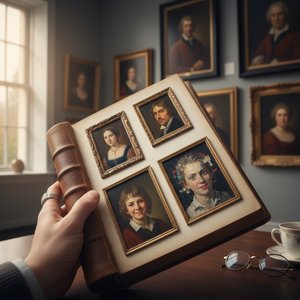
The Elegant Brush of Leonardo Gasser
In the vibrant landscape of nineteenth-century Italian art, few names evoke the refined grace of the Victorian era quite like Leonardo Gasser. Born in Florence in 1831, Gasser emerged from a rich cultural milieu that celebrated both classical tradition and a burgeoning romanticism. As a dedicated figure painter, his life and work were deeply intertwined with the aesthetic sensibilities of his time, capturing not just the likenesses of his subjects, but the very essence of their social standing and quiet, intimate moments.
Gasser’s artistic journey was profoundly shaped by his apprenticeship under the esteemed portraitist Michael Gordigiani in Florence. From his mentor, Gasser inherited a mastery of the human form and a penchant for elegance that would become the hallmark of his career. This lineage is evident in his ability to render skin tones with a luminous quality and to drape figures in fabrics that seem to possess their own weight and luster. His training allowed him to move beyond mere representation, transitioning into a style where the sitter’s character is revealed through subtle gestures and a sophisticated use of light.
A Mastery of Portraiture and Atmosphere
The works of Gasser are often characterized by a romanticized approach to his subjects, particularly when depicting women. He possessed a unique talent for creating scenes that feel both private and profoundly poised. In masterpieces such as Two Sisters, the viewer is invited into a domestic sanctuary, witnessing a moment of leisure shared between two young women amidst the opulent textures of the era. Through his brush, we see the intricate details of lace, the heavy sheen of silk, and the delicate glimmer of pearls—elements that serve to anchor the subjects in their historical context while elevating the scene to something timeless.
His technical prowess extended to a refined palette that could shift from the soft, warm tones of a sunlit parlor to the deep, dramatic shadows of a more contemplative setting. This versatility allowed him to command attention in the major art centers of Italy. Throughout his active years, Gasser was a frequent presence in the prestigious exhibition halls of:
- Milan
- Torino
- Genova
By exhibiting in these cultural hubs, he solidified his reputation as a premier painter of the Italian upper class, capable of translating the fashion and decorum of the 1870s into enduring visual narratives.
Legacy and Historical Significance
Though his career reached its zenith during the late nineteenth century, Gasser’s impact remains felt in the study of Italian figurative art. His ability to blend the meticulous detail of academic training with a soft, romanticized atmosphere makes his work a vital window into the social fabric of the 1800s. He did not merely paint people; he painted an era of poise, where every fold of a velvet sleeve and every tilt of a head spoke of a specific, vanished elegance.
Today, collectors and historians look to Gasser to understand the intersection of portraiture and social history. His paintings, such as The Flower Girl and Curiosity, continue to resonate because they capture the universal human desire for beauty and connection. As a pupil of Gordigiani and a master in his own right, Leonardo Gasser remains a significant figure whose brushwork continues to whisper the stories of a sophisticated, bygone world.
Q&A
Leonardo Gasser의 작품을 컬러 팔레트별로 둘러볼 수 있나요?
컬러 팔레트별로 보기 페이지에서는 Leonardo Gasser의 작품들을 색상 팔레트별로 모아볼 수 있습니다.
Leonardo Gasser의 예술 세계는 시간이 흐름에 따라 어떻게 진화했나요?
Leonardo Gasser의 예술적 여정은 연대기 페이지에서 시기별로 펼쳐집니다. 이곳에서는 작가의 활동 시기를 장(chapter)으로 나누어 작품들을 연대순 타임라인 형태로 한눈에 확인할 수 있습니다.
Leonardo Gasser의 작품 전체 목록을 볼 수 있는 곳이 있나요?
이 사이트에 등록된 Leonardo Gasser의 모든 작품은 작가의 전체 작품 보기 페이지에서 만나보실 수 있습니다.
Leonardo Gasser은(는) 어느 시대의 작품을 남겼나요?
Leonardo Gasser은(는) 19th Century 시대에 활동했습니다. 이 시기는 역사적 맥락 속에서 작가의 예술적 위치를 보여줍니다.