A Life Immersed in Blooms: The Serene World of Leonard Daniel Philpot
Leonard Daniel Philpot, born in London in 1877 and passing away in 1973, was a British painter whose artistic journey spanned both the decorative arts movement and a quiet dedication to still life and landscape. While his brother, Glyn Philpot, achieved greater renown for his figurative work, Leonard carved out a distinctive niche for himself with exquisitely rendered floral studies and tranquil scenes that evoke a sense of peaceful contemplation. His story is one of architectural training informing a painterly sensibility, a practice honed through travel and observation, ultimately resulting in works celebrated for their delicate detail and harmonious color palettes. Philpot’s early life saw him studying architecture at the South Kensington Schools – an education which instilled within him a keen understanding of form, structure, and perspective. This foundation would prove crucial to his later artistic endeavors, providing a framework for the meticulous compositions that characterize his paintings. He didn't limit himself to Britain; he practiced his architectural skills in China and America, broadening his horizons and undoubtedly influencing his aesthetic sensibilities with exposure to diverse cultures and landscapes.From Architecture to Artistic Flourishing
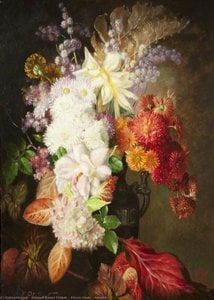
The transition from architect to painter wasn’t abrupt but rather a gradual unfolding of artistic inclination. Philpot's paintings are not merely representations of flowers or scenes; they are studies in light, texture, and the ephemeral beauty of nature. He possessed an exceptional ability to capture the subtle nuances of color and form, creating works that feel both realistic and imbued with a gentle romanticism. His floral still lifes, often reminiscent of Dutch Golden Age masters, showcase an intricate attention to detail – each petal, leaf, and stem rendered with precision and care. “Flower Study (Autumn)”, for example, is a testament to this skill, its warm tones and delicate brushwork evoking the richness and transience of the season. Beyond still life, Philpot also painted serene landscapes, capturing the quiet beauty of the English countryside. These works often feature soft lighting and muted colors, creating an atmosphere of tranquility and peace.Influences and Artistic Development
While Philpot’s work doesn't align neatly with any single artistic movement, it reveals influences from several sources. The Dutch Golden Age painters – particularly those specializing in floral still life – are evident in his meticulous technique and attention to detail. The Pre-Raphaelites, with their emphasis on naturalism and romantic themes, also seem to have left a mark on his work. However, Philpot developed a style that was uniquely his own, characterized by a sense of quiet intimacy and harmonious color palettes. His architectural background undoubtedly played a role in this development, providing him with the skills necessary to create balanced and well-composed paintings. He wasn’t interested in grand narratives or dramatic gestures; instead, he focused on capturing the subtle beauty of everyday life – a single flower, a peaceful landscape, a quiet moment of contemplation.Major Achievements and Recognition
Although not as widely celebrated during his lifetime as some of his contemporaries, Leonard Daniel Philpot's work has gained increasing recognition in recent years. His paintings are held in numerous public and private collections, and he is represented in the collection of the George Daniell Museum.- His ability to capture the delicate beauty of nature with such precision and care sets him apart.
- The serene atmosphere of his landscapes offers a welcome respite from the chaos of modern life.
- His work provides a fascinating glimpse into the artistic sensibilities of early 20th-century Britain.
Historical Significance and Lasting Legacy
Leonard Daniel Philpot's historical significance lies in his dedication to capturing the subtle beauty of everyday life. In an era marked by rapid social and technological change, he chose to focus on timeless themes – the beauty of nature, the tranquility of the countryside, the simple pleasures of existence. His work serves as a reminder that even in the midst of chaos and upheaval, there is still beauty to be found in the world around us. While his brother Glyn Philpot’s legacy rests largely on his striking portraiture, Leonard's contribution lies in creating a body of work that offers a quiet counterpoint – a serene and contemplative vision of the natural world. His paintings continue to resonate with viewers today, offering a welcome escape from the stresses of modern life and a reminder of the enduring power of beauty.Q&A
Leonard Daniel Philpot 작가 작품의 컬러 프로필은 어디에서 확인할 수 있나요?
Leonard Daniel Philpot의 팔레트 지놈에서는 작가의 작품 세계를 구성하는 컬러 프로필을 확인하실 수 있습니다.
Leonard Daniel Philpot가 그린 모든 주제를 한눈에 볼 수 있는 개요가 있나요?
주제별 작품 모음 페이지에서는 Leonard Daniel Philpot의 작품들을 주제별로 확인하실 수 있습니다.
Leonard Daniel Philpot의 예술 세계는 시간이 흐름에 따라 어떻게 진화했나요?
Leonard Daniel Philpot의 작품 세계를 시간순으로 정리한 기록은 아티스트 연대기 페이지에서 확인하실 수 있으며, 이곳에서는 각 시기별로 분류된 챕터를 따라 작품들을 제작 순서대로 만나보실 수 있습니다.
Leonard Daniel Philpot의 다른 이름이나 별칭에는 무엇이 있나요?
Leonard Daniel Philpot은(는) Leonard Daniel Philpot (1877–1973), L. D. Philpot라는 이름으로도 활동하고 있습니다.