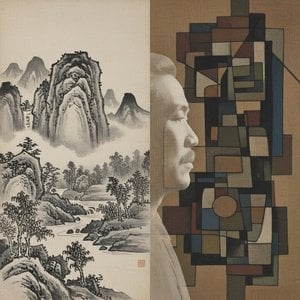
Lee Boon Wang: A Life in Landscapes
Early Life and Education
- Born in Guangdong, China in 1934, Lee Boon Wang’s early life was marked by a significant relocation. He emigrated to Singapore with his family as a child, establishing roots in a new cultural landscape.
- He received his formal artistic training at the Nanyang Academy of Fine Arts, graduating in 1953. This institution played a crucial role in shaping his artistic foundation and connecting him with a burgeoning community of Singaporean artists.
Early Career and Influences
- Initially, Lee Boon Wang pursued a career in education, returning to the Nanyang Academy of Fine Arts as a teacher. This period allowed him to share his knowledge and passion for art with aspiring students.
- He later transitioned into the world of advertising, working first at S.H. Benson and subsequently at Leo Burnett Worldwide. While seemingly a departure from fine arts, this experience honed his visual communication skills and provided financial stability.
- His artistic influences during these formative years are not explicitly documented but likely included both traditional Chinese landscape painting techniques and the emerging trends in Western realism.
Artistic Development and Style
- By the 1970s, Lee Boon Wang dedicated himself fully to his passion: landscape painting. He became particularly renowned for his depictions of Singapore’s riversides and seasides.
- His style is characterized by realism, capturing the subtle nuances of light, atmosphere, and texture in his scenes. His paintings evoke a sense of tranquility and connection to nature.
- He was drawn to portraying everyday life along Singapore’s waterways, documenting a rapidly changing urban landscape.
Major Achievements and Recognition
- Lee Boon Wang's work gained significant recognition within Singapore. Many of his paintings were acquired by the National Gallery Singapore, solidifying his place in the nation’s artistic heritage.
- His art was frequently exhibited at prominent venues such as the Ngee Ann Cultural Centre and the Empress Place Museum Gallery, reaching a wide audience.
- He co-founded the Equator Art Society, a left-leaning realist organization in the mid-1950s. This demonstrates his commitment to using art as a medium for social commentary.
- Later, he joined the Singapore Watercolour Society, further expanding his artistic pursuits and connections within the local art community.
Personal Life and Legacy
- Lee Boon Wang came from a notable family. His brother, Lee Boon Yang, became a successful businessman and politician, while his sister, Lee Boon Ngan, married the painter Chua Mia Tee.
- He had a son and two daughters from his first marriage and enjoyed a four-decade long marriage to Helen Teo.
- Lee Boon Wang passed away on October 30, 2016, at St Andrew’s Community Hospital in Singapore after battling pancreatic and colon cancer.
- His legacy endures through his evocative paintings, which continue to capture the beauty and spirit of Singapore's landscapes.
Historical Significance
- Lee Boon Wang’s work provides a valuable visual record of Singapore’s transformation during the latter half of the 20th century. His paintings offer insights into the nation’s evolving relationship with its natural environment.
- As a member of the Equator Art Society, he contributed to a significant movement in Singaporean art history, advocating for realism and social engagement.
Q&A
Lee Boon Wang의 작품을 색상별로 찾아볼 수 있나요?
Lee Boon Wang의 작품은 작가의 컬러 인덱스 페이지에서 색상별로 감상하실 수 있습니다.
Lee Boon Wang 작가의 작품을 감상할 수 있는 3D 갤러리는 어디인가요?
Lee Boon Wang의 작품은 작가의 3D 갤러리 페이지 내 3D 갤러리에서 감상하실 수 있습니다.
Lee Boon Wang은(는) 어느 시대의 작품을 남겼나요?
Lee Boon Wang은(는) Modern 시대에 활동했습니다. 이 시기는 역사적 맥락 속에서 작가의 예술적 위치를 보여줍니다.
Lee Boon Wang의 작품을 분위기별로 모아둔 곳은 어디인가요?
아티스트의 무드 룸 페이지에서는 Lee Boon Wang의 작품들을 분위기에 따라 큐레이션된 형태로 만나보실 수 있습니다.