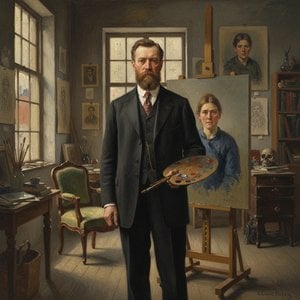
The Tapestry of a Life: The Artistry of Kris Torne
Born into the cultural landscape of Norway in 1867, Kristine Laache—known to history as Kris Torne—was an artist whose creative spirit refused to be confined by a single medium. Her journey began in the heart of Scandinavia, shaped by a lineage of intellectual rigor and a deep-seated passion for the visual arts. As a young woman, she immersed herself in the rigorous training of the era, studying under luminaries such as Eilif Peterssen and Harriet Backer. These early mentors instilled in her a mastery of light and form, laying the foundation for a career that would eventually bridge the gap between the fine arts of painting and the intricate, tactile world of textile design.
The 1890s marked a transformative period for Torne, characterized by a movement toward atmospheric depth and emotional resonance. In 1894, she became a vital participant in the legendary Vågåsommeren artists' colony, an event that would redefine Norwegian painting. Alongside a cohort of visionary peers, she sought to move away from the stark clarity of traditional Realism, embracing instead a more evocative approach defined by deeper colors and simplified, mood-driven compositions. This period of experimentation was not merely about technique; it was about capturing the very soul of the landscape through a lens of soft light and poetic suggestion.
A Union of Vision and Craft
In 1897, Torne’s personal and professional lives became inextricably linked when she married the esteemed painter Oluf Wold-Torne. This union blossomed into one of the most significant artistic partnerships in Norwegian history. While her early years were defined by the pursuit of landscapes and portraits—achievements that earned her prestigious recognition, including a prize at the 1900 Paris Exposition—her creative focus underwent a profound evolution. Following 1906, Torne began to channel her painterly sensibilities into the realm of textiles, breathing life into embroidered works and magnificent rugs.
This transition was far from a departure from her roots; rather, it was an expansion of them. Using the cartoons and designs created by her husband as a blueprint, she translated the fluid motions of paint onto the structured surfaces of fabric. Her work in textiles allowed for a unique interplay of texture and color, turning functional objects into woven masterpieces. Through this medium, she achieved a rare synthesis of decorative elegance and fine art sensibility, ensuring that her influence reached beyond the canvas and into the very fabric of domestic beauty.
Legacy and Artistic Significance
The legacy of Kris Torne is one of versatility and enduring grace. Her ability to navigate the shifting tides of art history—from the pursuit of atmospheric realism to the pioneering of decorative textile arts—marks her as a true polymath of the Norwegian art scene. Her contributions were not limited to individual creation but extended to the collective spirit of her time, notably through her involvement in Den dekorative forening (The Decorative Society), which sought to elevate the status of decorative arts.
Today, we remember Torne not just as a painter of landscapes or a weaver of rugs, but as an artist who understood that beauty could be found in both the fleeting light of a summer afternoon and the permanent, intricate stitch of an embroidery. Her life, which concluded in Florence, Italy, remains a testament to the power of artistic evolution and the seamless integration of different creative disciplines.
Q&A
주제별로 분류된 Kris Torne의 작품들은 어디에서 확인할 수 있나요?
Kris Torne의 작품은 작가의 주제별 작품 모음 페이지에서 주제별로 찾아보실 수 있습니다.
Kris Torne의 작품을 사조별로 둘러볼 수 있나요?
Kris Torne의 작품은 작가의 모든 미술 사조 페이지에서 사조별로 만나보실 수 있습니다.
Kris Torne의 작품 중 조회수가 가장 높은 것은 무엇인가요?
Kris Torne 작가의 작품 통계 정보는 방문 통계 페이지에서 확인하실 수 있습니다.
특정 색상 팔레트의 Kris Torne 작품은 어디에서 찾아볼 수 있나요?
Kris Torne의 작품은 작가의 컬러 팔레트별로 보기 페이지에서 컬러 팔레트별로 만나보실 수 있습니다.