Keith Milow: Architect of Enigmatic Space
Born in London in 1945, Keith Milow’s artistic journey is a compelling narrative of transatlantic exploration and the relentless pursuit of formal experimentation. From his early years in Baldock, Hertfordshire, to his periods living and working in New York City (1980-2002) and Amsterdam (2002-2014), culminating in his current residence in London, Milow has consistently pushed the boundaries of sculpture, painting, and printmaking. His work isn’t merely decorative; it's a deliberate investigation into the relationship between structure, material, and meaning – often imbued with a profound sense of mystery and poetic resonance.
Milow’s formal training at Camberwell School of Art and the Royal College of Art provided him with a rigorous foundation in traditional techniques. However, he quickly moved beyond these established methods, forging his own distinctive language characterized by architectural precision, monumental scale, and an engagement with process. Influenced by post-minimalism and the conceptual currents of the 1970s, Milow sought to dismantle conventional distinctions between painting and sculpture, creating works that exist simultaneously as objects and visual propositions. His early career coincided with a vibrant period of artistic innovation in Britain, placing him alongside influential figures like Richard Long, Gilbert & George, and Michael Craig-Martin – artists who similarly challenged the established norms of the art world.
The Cross Motif and Material Alchemy
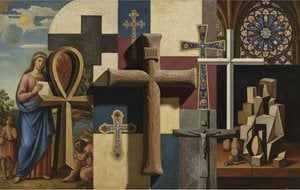
A recurring motif throughout Milow’s oeuvre is the Latin cross, a symbol that has occupied human consciousness for centuries. He didn't simply depict crosses; he meticulously constructed them from lead and copper, often layering these materials to create complex, textured surfaces. This fascination with the cross isn’t merely symbolic; it represents a fundamental exploration of form, structure, and the inherent qualities of the chosen materials. The process of oxidation, in particular, played a crucial role in his work, transforming the cold, metallic surfaces into rich, evocative landscapes of rust and patina – a deliberate act of material alchemy.
Milow’s approach extended beyond simple representation. He frequently incorporated names of influential artists—particularly Piet Mondrian—into his paintings and drawings, creating dialogues across time and artistic lineages. These references weren't intended as mere homage but rather as points of departure for his own explorations, suggesting a continuous conversation between the past and the present. As art historian Jo Melvin aptly described, Milow’s work is “infused in the history of painting, the subject of painting and its meaning. Something else slips through in the game of chance. It is a piece of magic – the combination of mystery with structure, order and process.”
Sculptural Series and Monumental Forms
Perhaps most notably, Milow developed a series of disc-shaped sculptures known as ‘tondi’ during the 1990s. These works, often executed in bronze or other metals, are not simply decorative objects but rather monumental meditations on form and space. The 'tondi' can be seen as an extension of his earlier explorations with the cross motif, representing a distilled essence of geometric structure. Milow’s scale is deliberately imposing, creating a sense of presence and gravitas that invites contemplation.
Beyond the ‘tondi’, Milow has produced a vast body of work encompassing drawings, paintings, and prints. His process often involves meticulous layering, precise detailing, and an awareness of the inherent qualities of each material. He frequently employs techniques borrowed from ancient crafts—such as etching and woodblock printing—to create intricate patterns and textures that add layers of complexity to his compositions.
Recognition and Legacy
Throughout his career, Keith Milow has received numerous accolades recognizing his contributions to contemporary art. These include the Calouste Gulbenkian Foundation Award (1976), the Arts Council of Great Britain Major Award (1979), and the Edward Albee Foundation Award (1983). His work is held in prominent public collections around the world, including those of the National Gallery of Australia, the Irish Museum of Modern Art, and numerous museums and galleries across Europe and North America.
Milow’s influence extends beyond his own artistic output. He has taught at prestigious institutions such as Chelsea School of Art and Kent State University, shaping the next generation of artists. His work continues to be exhibited internationally, cementing his place as a significant figure in British contemporary art – an artist who consistently challenges our perceptions of form, material, and meaning through his uniquely enigmatic and poetical creations.
Q&A
Keith Milow의 전 작품에 걸친 색채 활용을 살펴볼 수 있을까요?
Keith Milow의 팔레트 지놈에서는 작가의 작품 세계를 구성하는 컬러 프로필을 확인하실 수 있습니다.
Keith Milow의 작품을 매체별로 찾아볼 수 있나요?
특정 매체로 제작된 Keith Milow의 모든 작품을 확인하시려면, 작가의 모든 매체별 페이지를 이용해 주세요.
Keith Milow의 작품 중 조회수가 가장 높은 것은 무엇인가요?
Keith Milow의 방문 통계 페이지에서는 이 사이트에 등록된 작가의 작품들을 바탕으로 산출된 통계 정보를 제공합니다.
Keith Milow 작품의 연도별 타임라인이 있나요?
Keith Milow의 작품을 연도별로 정리하여 보여주는 작품 연대기 페이지입니다.