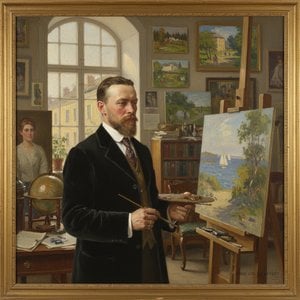
The Quiet Life of Johan Alfred Pettersson
Born in Helsinki, Finland, on January 31, 1887, the man who would later be known as Jonas Peson began his life as Johan Alfred Pettersson. His early years were shaped by a technical discipline, as he trained as a lithographer before pursuing the finer studies of the Academy of Fine Arts in Helsinki. By 1910, he had completed his formal education, a foundation that would support a life of constant movement and artistic evolution. He was a man of many names and many places, moving through the landscapes of Russia and Denmark before finding a permanent home in Norway.
His path was one of steady migration. After spending time in Denmark starting in 1913, he moved to Norway in 1916. He lived in various towns, eventually settling in Ålesund in the mid-1920s. This transition from his Finnish roots to a Norwegian identity was more than a change of scenery; it was a shift in the very soul of his work. He eventually became a Norwegian citizen in 1923, a formal recognition of the place he had chosen to call home.
A Changing Eye
The way Pettersson saw the world shifted as he aged. In his younger years, he found himself drawn to the fragmented structures of French cubism, experimenting with how shapes and planes could define a subject. However, as the years passed, his brushwork moved toward a simpler, more direct naturalism. He became a painter of the tangible and the local, finding beauty in the everyday details of the Norwegian coast.
His subjects were often found in the salt air and the quiet corners of his surroundings. He focused on several specific themes throughout his career:
- Landscapes and the dramatic views of the fjords.
- The busy, working life of the harbor in Ålesund.
- Still life arrangements and intimate portraits.
- Religious scenes and decorations for local churches.
This versatility allowed him to move between the public and the private. He was as comfortable painting the choir walls of Stranda Church in the 1940s as he was capturing a quiet moment in a summer cottage in Sykkylven. His work was not about grand gestures, but about the honest depiction of light and environment.
Legacy in Color and Form
Pettersson’s contribution to the visual life of his community was deeply felt through his commissions. He decorated not only churches like Vartdal, but also schools and youth houses across Sunnmøre. These works brought his art into the daily lives of the people, making his vision a part of their shared social fabric. Whether working in oil, watercolor, or fresco, he remained committed to the essence of his subject.
He passed away in Ålesund on December 18, 1952. He left behind a body of work that reflects a life spent observing the world with a steady, evolving gaze, moving from the complexities of modernism to the clarity of the natural world.
Q&A
Jonas Pettersson의 작품 중 몇 점을 둘러보실 수 있나요?
전체 작품 보기 페이지에서 Jonas Pettersson의 작품 작품 1점점을 만나보실 수 있습니다.
Jonas Pettersson의 작품을 매체별로 찾아볼 수 있나요?
특정 매체로 제작된 Jonas Pettersson의 모든 작품을 확인하시려면, 작가의 모든 매체별 페이지를 이용해 주세요.
Jonas Pettersson의 작품을 컬러 팔레트별로 둘러볼 수 있나요?
특정 색상 팔레트의 Jonas Pettersson 작품을 찾으시려면, 작가의 컬러 팔레트별로 보기 페이지를 이용해 보세요.
Jonas Pettersson의 작품을 사조별로 둘러볼 수 있나요?
Jonas Pettersson 작가의 작품을 예술 사조별로 모아둔 모든 미술 사조 페이지에서 해당 작가가 활동했던 사조를 확인하실 수 있습니다.