Early Life and Artistic Training
Born in the rural settlement of Ironbark, New South Wales, in 1873, John Salvana spent his earliest years far from the bustling centers of the art world. As a child, he was known by the nickname Jack, a name that followed him through a youth shaped by the quiet landscapes of the Australian country. This upbringing in a remote region instilled in him a deep, personal longing to witness the beauty of fine art, a desire that grew as he realized how limited his opportunities were to encounter such things firsthand. He was a country boy who looked toward the horizon with a quiet ambition to understand the visual language of the world around him.
This early hunger for knowledge eventually led him away from the isolation of his birthplace and toward formal instruction. He sought out the Royal Art Society School in Sydney, where he began to refine his technical skills and learn the discipline required of a professional painter. His talent and curiosity could not be contained by the borders of his home country alone. Seeking to expand his understanding of light and form, he traveled to London to continue his studies, immersing himself in the traditions of a different hemisphere. These years of training, spanning from the classrooms of Sydney to the studios of London, provided the foundation for the man who would eventually return to his roots to share his vision with others.
Artistic Style and Key Works
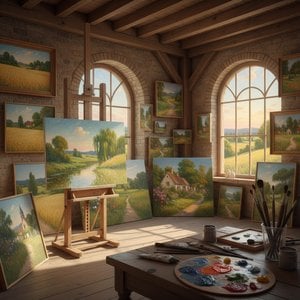
His brush sought to capture the quiet essence of the Australian landscape, leaning heavily into an impressionistic style that favored light and atmosphere over rigid precision. He found his greatest inspiration in the rural and regional stretches of New South Wales, turning his gaze toward the bush scenes that defined the character of the country. Through his oils, the sprawling vistas of the coast and the rugged interior were brought into focus, reflecting a deep connection to the terrain of his home.
This devotion to the landscape earned him significant recognition within the Australian art community. In 1950, he was honored with the Wynne Prize for his depiction of Yarramalong Valley, NSW. He returned to this high honor just two years later, securing the Wynne Prize in 1952 for his portrayal of Burragorang Valley. These achievements highlighted his ability to translate the specific textures of the Australian wilderness onto canvas.
His earlier works also demonstrated a keen eye for the shifting moods of the natural world. In 1913, he painted Afternoon on the Namoi, a work that captured a specific moment of light and shadow. His ability to render the subtle nuances of the bush allowed him to move beyond mere representation, seeking instead to convey the very spirit of the land through his compositions.
The Salvana Collection and Legacy
In June 1919, Salvana made a decision that would forever alter the cultural landscape of the region. He gifted the Salvana Collection to the Tamworth Regional Gallery, a gesture that directly led to the establishment of Tamworth’s first public art gallery. This collection was not merely a collection of finished pieces; it comprised over 100 paintings and works on paper, including many works by his friends and associates. He sought to provide a rural center with a space where art could be seen firsthand, driven by a desire to encourage young children and those with an interest in the arts to study the craft.
His generosity was guided by a specific pedagogical intent. Among the gifted works were unfinished artworks, which he included so that students might gain a visual understanding of how a painting or drawing is constructed. He believed that by seeing these works in progress, a student could better grasp the mechanics of the medium. This thoughtful inclusion turned the collection into a practical educational resource for the community. He even imposed conditions on the gift to ensure the care, storage, and preservation of the works for future generations, hoping the public would develop a lasting appreciation for Australian artists and their labor.
Q&A
키워드로 John Salvana의 작품을 찾아볼 수 있나요?
John Salvana의 키워드별 탐색 페이지에서는 작가의 작품들을 키워드별로 모아볼 수 있습니다.
주제별로 분류된 John Salvana의 작품들은 어디에서 확인할 수 있나요?
John Salvana의 작품은 작가의 주제별 작품 모음 페이지에서 주제별로 찾아보실 수 있습니다.
John Salvana의 활동 시기는 어떻게 구분되어 있나요?
John Salvana의 작품 세계를 시간순으로 정리한 기록은 아티스트 연대기 페이지에서 확인하실 수 있으며, 이곳에서는 각 시기별로 분류된 챕터를 따라 작품들을 제작 순서대로 만나보실 수 있습니다.
John Salvana의 출생지와 출생 연도는 어떻게 되나요?
John Salvana은(는) 1873년 Ironbark에서 태어났습니다.