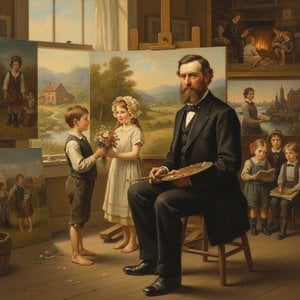
A Life Shaped by the Capital
Born in 1913, John Gernand grew up amidst the quiet, structured streets of Capitol Hill in Washington. His path was initially steered by familial expectations toward the rigid discipline of architecture at the University of Illinois. He found the technical demands of the field difficult, a struggle he later admitted was less about a lack of intellect and more about a lack of personal inclination. A sudden bout of anemia during his third year of study provided an unexpected redirection, forcing a return to Washington and a departure from the drafting table.
This return allowed him to pursue the fine arts, a decision met with hesitation by his parents. He eventually found his footing at a new art school associated with the Phillips Collection, where he was among the first three students to enroll. This institution would become the center of his professional life, providing the technical foundation that would define his later years as both a creator and a guardian of art history.
The Duality of Practice
Gernand’s career was marked by a transition in medium and a deep connection to the institutions that housed his work. While his early years were defined by painting, his later development saw him evolve into a superb printmaker. His professional life was inextricably linked to the Phillips Collection, where he served as Registrar and Archivist, ensuring the preservation of the very types of works he sought to produce.
His artistic output during the mid-century period included several notable works that found their way into permanent collections:
- Construction (1936)
- Evening Garden (1938)
- Circus (1938)
- Across the Field (1940)
- Evening Stars (1942)
- The Voyage of Bacchus (1943)
- Blowing Leaves (1944)
- City (1945)
- Vignetted Bouquet (1946)
- The House Next Door (1951)
Recognition and Legacy
Though he was a significant figure in the Washington art scene, Gernand’s influence was often felt through his meticulous stewardship of museum archives. He was a member of the Art Guild of Washington and participated in various exhibitions, including the 1939 Corcoran Biennial and a solo show at the Phillips Collection. His presence in the art world was documented in Who Was Who in American Art, marking him as a recognized figure in the American landscape.
He remained a fixture of the Washington art community until his death in 1990. His legacy is held within the collections of the Phillips Collection, where his paintings and prints continue to represent the technical skill and evolving vision of a man who found his true calling only after abandoning the blueprints of his youth.
Q&A
John Gernand 작가의 작품에서 가장 자주 나타나는 색상은 무엇인가요?
이 사이트에 등록된 작품 전반에 나타나는 John Gernand의 색채 활용은 작가의 팔레트 지놈 페이지에서 자세히 살펴보실 수 있습니다.
John Gernand의 작품은 얼마나 인기가 있나요?
이 사이트에서 John Gernand의 작품에 관한 통계를 확인할 수 있는 방문 통계 페이지를 만나보세요.
John Gernand의 작품들은 어떤 분위기를 담고 있나요?
John Gernand의 작품은 각 작품이 지닌 분위기에 따라 분류된 무드 룸 페이지에서 무드별로 감상하실 수 있습니다.
John Gernand의 활동 시기는 어떻게 구분되어 있나요?
John Gernand의 작품 세계를 시간순으로 정리한 기록은 아티스트 연대기 페이지에서 확인하실 수 있으며, 이곳에서는 각 시기별로 분류된 챕터를 따라 작품들을 제작 순서대로 만나보실 수 있습니다.