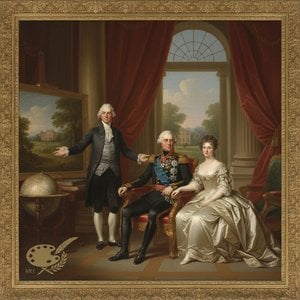
The Luminous Legacy of John Dawson Watson
In the golden age of Victorian artistry, few hands could capture the delicate interplay of light and sentiment as gracefully as John Dawson Watson. Born in 1832 amidst the rugged beauty of Sedbergh, Yorkshire, Watson was a painter whose soul seemed inextricably linked to the atmospheric nuances of the natural world. He was an artist of profound sensitivity, a master of the watercolor medium who possessed the rare ability to transform a simple panel or board into a window of emotional depth. His life’s work, characterized by a luminous color palette and a meticulous attention to detail, established him as a significant figure in the movement of tonal Impressionism within Scotland and beyond.
Watson’s journey toward artistic mastery was paved with rigorous classical training and transformative encounters. Following his early education at King Edward VI Grammar School, he immersed himself in the creative ferment of the Manchester School of Design. It was during this formative period that he met the American artist Mark Fisher, a mentorship that would later propel him toward the heart of the European avant-garde. In 1856, Watson ventured to Paris, where the revolutionary air of the Impressionist movement awaited him. Studying under masters such as Carolus-Duran and Léon Glaize, he absorbed the radical new ways of perceiving light and shadow, an experience that would forever alter his aesthetic sensibilities and infuse his later works with a breathtaking, atmospheric vitality.
A Tapestry of Genre and Illustration
While Watson’s technical prowess was evident in his landscapes, it was in his intimate genre scenes that he truly captured the Victorian heart. He became celebrated for his ability to depict small, poignant figure subjects—often featuring couples of lovers, solitary females, or the innocent charm of young children. These works, frequently executed on a small scale, possessed a Pre-Raphaelite sensibility, characterized by an exquisite reverence for color and a precision in texture that invited the viewer into a private, quiet moment of reflection. His paintings of the Scottish Highlands, particularly the dramatic vistas of Loch Lomond and Glencoe, stand as testaments to his Romantic spirit, blending topographical accuracy with an emotive, misty grandeur.
Beyond the canvas, Watson was a prolific and highly regarded illustrator, a role that allowed him to weave his visual narratives into the very fabric of 19th-century literature. His delicate line work and evocative compositions graced the pages of prestigious periodicals such as Once a Week and London Society. Perhaps most significantly, his illustrations for timeless classics like The Arabian Nights and Pilgrim’s Progress helped shape the visual imagination of an entire generation. This dual mastery of fine art and book illustration ensured that his artistic vision reached far beyond the walls of elite galleries, touching the lives of the reading public across the British Isles.
Artistic Heritage and Enduring Significance
The significance of John Dawson Watson lies not only in his individual achievements but in the enduring lineage of talent he helped foster. His influence can be seen in the way he bridged the gap between the meticulous detail of the Pre-Raphaelites and the fluid, light-drenched experiments of the Impressionists. His family was itself a cornerstone of the era's artistic community; his son, Dawson Dawson-Watson, would go on to become a prominent Impressionist painter in America, carrying the family’s devotion to light into a new century and continent.
Today, Watson’s legacy is preserved within the hallowed halls of some of the world's most prestigious institutions. His contributions to the art historical canon are marked by several key milestones:
- Exhibition Eminence: Regular recognition at the Royal Academy, the British Institution, and the Royal Watercolour Society.
- Mastery of Medium: A pioneering approach to watercolor that emphasized tonal depth and atmospheric effects.
- Institutional Recognition: The presence of his works in permanent collections such as the Victoria and Albert Museum and the Tate.
- Literary Impact: A lasting contribution to the visual culture of Victorian literature through high-quality book illustration.
As we look back upon the career of John Dawson Watson, we see more than just a painter of scenes; we see a chronicler of emotion. Through his ability to capture the fleeting shimmer of light on water or the tender gaze of a child, he provided a visual language for the ephemeral beauty of life itself.
질의응답
미술 사조별로 분류된 John Dawson Watson의 작품은 어디에서 볼 수 있나요?
John Dawson Watson의 작품은 작가의 모든 사조 페이지에서 사조별로 둘러보실 수 있습니다.
John Dawson Watson의 경력은 어떻게 시기별로 구분되어 있나요?
John Dawson Watson의 예술적 여정은 연대기 페이지에서 시기별로 펼쳐집니다. 이곳에서는 작가의 활동 시기를 장(chapter)으로 나누어 작품들을 연대순 타임라인 형태로 한눈에 확인할 수 있습니다.
John Dawson Watson 작가의 작품을 연도별로 어떻게 확인할 수 있나요?
John Dawson Watson의 작품 연표를 확인해 보세요: 작품 연대기 페이지에서 작품들을 제작 날짜순으로 보실 수 있습니다.