Early Life, Family and Training
Johan Sevenbom entered the world in 1721 in Närke, born to parents who lacked financial means. This scarcity defined his early years, forcing him to balance survival with his creative ambitions. By 1744, he moved to Stockholm to pursue formal training. His determination led to his admission as a student at the Stockholm Academy, marking the beginning of a disciplined technical progression.
His trajectory shifted significantly in 1750 when he traveled to Paris. This move made him the first Swedish student at the Paris Academy. He did not rely on leisure to master his craft; instead, he utilized the Academy's evening sessions to study the works of old masters and refine his drawing skills. This rigorous, self-directed approach in Paris provided the technical foundation that would define his later output. Later, in 1764, he married Catharina Elisabet Löfling.
Professional Career and Commissions
Sevenbom’s return to Stockholm in 1760 marked a shift from his formative years in Paris to a position of institutional importance. He secured work as a painter at Stockholm Palace, a role that solidified his standing within the Swedish capital. His technical proficiency led to significant commissions involving the Swedish landscape, specifically through a series of views of various castles. These works focused on the architectural presence of sites such as Drottningholm, Gripsholm, and Ulriksdal.
His output during the 1760s was defined by a rigorous, repetitive commitment to documenting the capital. He was tasked with producing a new view of Stockholm every year. This series eventually reached fifteen paintings, though his declining health prevented him from completing the final installment. This systematic approach to urban topography remains his most disciplined professional achievement. By 1773, his influence within the Swedish art establishment was formalized when he was appointed a professor at the Academy.
Key Works and Subjects
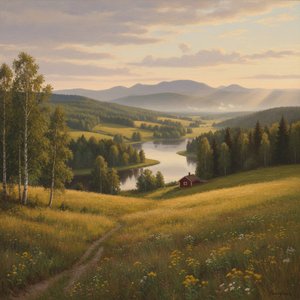
Sevenbom’s output is defined by a rigorous focus on the Swedish landscape and the architectural dignity of its royal estates. He moved beyond mere topographical recording to capture the specific character of the Swedish countryside. His compositions often centered on the relationship between water and land, exemplified by his landscape featuring a view over a lake and countryside. This ability to structure space through natural elements became a hallmark of his approach to the Swedish terrain.
His most significant contributions involve the documentation of major Swedish landmarks. He provided detailed visual records of several prominent castles, including Drottningholms slott and Ulriksdals slott. These works demonstrate a technical command of oil on canvas, capturing the scale and presence of these structures within their environments. His depiction of Gripsholms slott, executed about 1759, remains a notable example of his ability to translate monumental architecture into a formal pictorial language.
Beyond these large-scale royal commissions, his repertoire included more localized subjects. He produced a work titled Brunnsbacken, showing a capacity for capturing specific, identifiable locations. His work is characterized by this tension between the grand, sweeping views of national monuments and the more intimate, grounded observations of the Swedish landscape.
Where to See the Works Today
Sevenbom’s physical legacy remains scattered across several significant Swedish institutions, ensuring his topographical and landscape contributions are preserved within major collections. His paintings and drawings are held by the Nationalmuseum and the Stockholm City Museum. These collections provide the primary means of studying his technical approach to Swedish scenery and urban views.
Beyond the capital, his output is distributed among academic and regional repositories. The Uppsala University Library maintains works by the artist, while the Norrköping Art Museum also holds pieces from his career. These locations offer a broader view of how his depictions of Swedish architecture and landscapes were integrated into various public and private archives.
Other specific holdings include works located at the Stockholm City Hall and the Residence in Nyköping. These sites represent the enduring presence of his work within the administrative and historical fabric of Sweden. To see his specific contributions to the visual record of the eighteenth century, one must look to these diverse institutional collections.
Q&A
주제별로 Johan Sevenbom의 작품을 찾아볼 수 있나요?
Johan Sevenbom의 주제별 작품 모음는 작가의 작품들을 주제별로 찾아볼 수 있는 페이지입니다.
Johan Sevenbom의 활동 시기는 어떻게 구분되어 있나요?
Johan Sevenbom의 예술적 여정은 연대기 페이지에서 시기별로 펼쳐집니다. 이곳에서는 작가의 활동 시기를 장(chapter)으로 나누어 작품들을 연대순 타임라인 형태로 한눈에 확인할 수 있습니다.
특정 주제별로 Johan Sevenbom의 작품을 어떻게 찾아볼 수 있나요?
Johan Sevenbom의 작품은 아티스트의 키워드별 탐색 페이지에서 키워드별로 찾아보실 수 있습니다. 각 키워드를 통해 관련 작품들을 모아 감상하실 수 있습니다.
Johan Sevenbom의 작품 중 조회수가 가장 높은 것은 무엇인가요?
Johan Sevenbom 작가의 작품 통계 정보는 방문 통계 페이지에서 확인하실 수 있습니다.