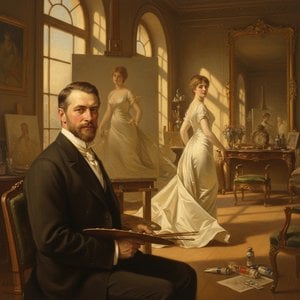
The Refined Elegance of Johan George Collasius
In the luminous tapestry of the Dutch Golden Age, few artists captured the delicate transition between classical restraint and the burgeoning opulence of the Rococo era as gracefully as Johan George Collasius. Born in Utrecht in 1698, Collasius emerged during a period when the somber, Protestant-driven realism of earlier Dutch masters was beginning to dance with the more decorative, aristocratic flourishes sweeping across Europe. His life and work serve as a window into an era of profound social change, where portraiture became not merely a record of a face, but a sophisticated language of status, texture, and light.
While the early chapters of his biography remain shrouded in the mists of time, the technical sophistication of his hand suggests a rigorous and prestigious education. It is believed that Collasius sought refinement in Haarlem, a vibrant epicenter of Dutch creativity, where he studied under the guidance of masters such as Willem van Gouda and Cornelis van Asselen. These mentors provided him with a foundation rooted in classical ideals, yet they also introduced him to the emerging Rococo tendencies that would later define his signature style. This unique pedagogical blend allowed Collasius to master the art of capturing anatomical precision while simultaneously embracing the ornamental splendor that characterized the eighteenth-century aesthetic.
A Mastery of Texture and Light
The true brilliance of Collasius lies in his ability to marry unflinching realism with a sense of theatrical grandeur. His technique, primarily centered on the use of oil on canvas, was nothing short of masterful. He possessed an uncanny ability to manipulate light to create luminous textures that seemed to breathe upon the surface of the canvas. To gaze upon a Collasius portrait is to experience the tactile reality of the subject's world; he did not merely paint fabric, he rendered the heavy weight of velvet, the shimmering translucence of silk, and the intricate, cold glint of fine jewelry.
This meticulous attention to detail extended far beyond the human form. Collasius utilized architectural settings and atmospheric backgrounds to imbue his subjects with a sense of permanence and nobility. His brushwork was disciplined yet capable of great delicacy, allowing him to capture the subtle nuances of an expression—a fleeting glance or a dignified repose—that conveyed the inner character of his sitters. This marriage of technical precision and decorative flourish made him a preferred choice for the era's elite, who sought portraits that functioned as both intimate psychological studies and grand social statements.
Legacy and Historical Significance
The historical significance of Johan George Collasius is most profoundly felt in his role as a chronicler of the European aristocracy. His commissions were more than mere artistic endeavors; they were vital instruments of visual commemoration for wealthy families and dignitaries. Through his work, we gain insight into the fashion, the social hierarchies, and the aesthetic aspirations of the 18th century. One of his most enduring achievements remains the monumental portrait of Hieronymus Josephus Boudaen, Lord of St Laurens and Popkensburg. In this piece, one can observe the pinnacle of his skill, where the subject's commanding presence is bolstered by the exquisite Rococo embellishments that define the period.
Though his life was relatively short, ending in 1736, Collasius left an indelible mark on the trajectory of Dutch portraiture. He stood at the crossroads of history, bridging the gap between the grounded traditions of his Dutch heritage and the airy, ornamental elegance of the French-influenced Rococo movement. His ability to synthesize these two seemingly disparate worlds ensures that his work remains a captivating study in the art of prestige, reminding us of a time when every brushstroke was an act of celebrating both the individual and the era's magnificent splendor.