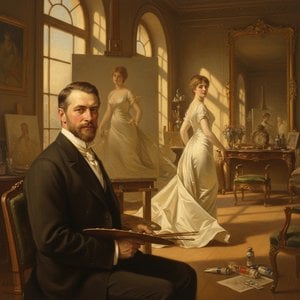
A Legacy of Light and Lineage: The Life of Jean Benner
The story of Jean Benner is one deeply woven into the very fabric of nineteenth-century French artistry, a narrative defined by familial bonds and a profound connection to the landscape. Born in 1836 in Mulhouse, Alsace, Jean entered the world as a twin alongside his brother, Emmanuel Benner. Their shared beginnings were rooted in the industrious spirit of their father, Jean Benner-Fries, whose work as a textile designer provided the brothers with an early education in pattern and precision. Before they were masters of the brush, the Benner brothers served as designers in the prominent mills and factories of Mulhoause, a period that undoubtedly instilled in them a meticulous eye for detail and a deep appreciation for the interplay of color and form that would later define their fine art.
As his innate talent blossomed, Jean sought to transcend the industrial design of his youth, embarking on a rigorous academic journey. He immersed himself in the prestigious traditions of French Academic painting, studying under luminaries such as Léon Bonnat, Eck, and the ethereal master Jean-Jacques Henner. This period of intense mentorship was transformative; from Henner, he inherited a sensitivity to light and shadow, while his exposure to the classical principles of his instructors allowed him to master the idealized beauty and technical precision required for the grand stages of the era. His official debut at the Paris Salon in 1868 served as a triumphant announcement of his arrival, marking the moment when his personal vision began to merge with the broader movements of European art.
The Spirit of Capri and Artistic Evolution
While his training was rooted in the rigorous academies of France, Benner’s soul found a profound resonance in the sun-drenched landscapes of the Mediterranean. His fascination with the island of Capri became a cornerstone of his creative identity. During an era when Capri served as a vibrant colony for the world's most celebrated painters, Benner was not merely a visitor but an active participant in its artistic community. He moved within the same circles as Frederic Leighton, John Singer Sargent, and Walter McLaren, finding in the island’s exotic flora and dramatic vistas a perfect subject for his evolving style.
This Mediterranean influence breathed a new vitality into his work, allowing him to expand his repertoire far beyond the confines of traditional portraiture. His output became a rich tapestry of diverse genres:
- Still Lifes: Brimming with vibrant color palettes that mirrored the exotic flora of Capri, these works showcased his ability to capture the fleeting beauty of nature.
- Portraits: Evocative studies that sought to capture the subtle nuances of human emotion and character.
- Genre Scenes: Captivating depictions of everyday life, often imbued with a sense of melancholic contemplation or quiet romanticism.
His technical achievements were recognized by his peers and institutions alike; notably, in 1881, he was awarded a medal at the Paris Salon for his painting Le Repos. This period of his career saw him producing works of significant scale and emotional depth, such as A House in Capri and Women of Capri, which demonstrated his ability to marry the grandiosity of Academic technique with the intimate, atmospheric qualities of the landscape.
Historical Significance and Artistic Enduring Presence
The historical significance of Jean Benner lies not only in his individual mastery but in his role as a bridge between the industrial precision of the mid-nineteenth century and the evocative, atmospheric sensibilities of the late century. He carried forward a family dynasty of creativity; as the father of the artist Emmanuel Michel Benner (known as Many Benner), he ensured that the Benner name remained synonymous with artistic excellence for another generation. His life was a testament to the idea that art is both a learned discipline and an inherited passion.
Though he passed away in Paris in 1906, his legacy remains preserved in the quiet beauty of his canvases. Through his ability to capture the light of Capri and the dignity of his subjects, Benner left behind a body of work that continues to resonate with those seeking the intersection of classical grace and natural splendor. His paintings remain enduring windows into a lost era of European elegance, reminding us of a time when the boundaries between the designer's hand and the painter's soul were beautifully blurred.
Q&A
Jean Benner의 작품 중 조회수가 가장 높은 것은 무엇인가요?
이 사이트에서 Jean Benner의 작품에 관한 통계를 확인할 수 있는 방문 통계 페이지를 만나보세요.
Jean Benner의 작품을 기법별로 모아볼 수 있는 곳은 어디인가요?
특정 매체로 제작된 Jean Benner의 모든 작품을 확인하시려면, 작가의 모든 매체별 페이지를 이용해 주세요.
Jean Benner 작품의 연도별 타임라인이 있나요?
Jean Benner의 작품을 연도별로 정리하여 보여주는 작품 연대기 페이지입니다.
Jean Benner의 다른 이름이나 별칭에는 무엇이 있나요?
Jean Benner은(는) Jean Benner the Younger, جان بنر, Жан Беннер라는 이름으로도 활동하고 있습니다.