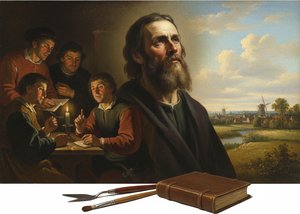
A Life in Bruges
Jan van Eeckele lived his life within the winding streets and quiet canals of Bruges. Born in the Netherlands around 1520, he was a man of his time, deeply connected to the local traditions of the Low Countries. His presence in the city was marked by his formal entry into the Guild of St. Luke in 1534, a step that solidified his place among the professional painters of the region. He remained a part of this community for the rest of his days, working and living in the same place until he passed away in November 1561.
His career was defined by a steady commitment to his craft. He did not wander far from his roots, finding his purpose in the religious and civic life of Bruges. The works he produced were intended for the sacred spaces of his community, providing visual focus for those gathered in prayer. His life was a quiet one, measured by the steady rhythm of the guild and the demands of his patrons.
The Hand of the Monogrammist
The identity of Jan van Eeckele has often been a subject of quiet study for those looking into the history of Netherlandish painting. Some scholars have noted a connection between his name and a specific set of initials found on certain works. This has led to discussions regarding his place in the broader history of the era's artistic production. His surviving legacy is tied to specific religious subjects that once graced the interiors of local churches:
- A Mater Dolorosa, which was held in the cathedral of St Salvator in Bruges.
- A Lactatio Bernardi, which belonged to the church of the Black Sisters.
These pieces offer a glimpse into the themes he chose to explore. His work was not about personal expression in the modern sense, but about fulfilling a role within the spiritual landscape of the sixteenth century. He was a painter who understood the weight of the imagery he was asked to create.
A Legacy in Color and Form
Though his time was relatively short, the impact of his work remains visible in the collections of museums today. His paintings have moved from the altars of Bruges to the halls of the Musée des Beaux-Arts in Tournai and the Sint-Salvatorskerk in Brugge. These locations preserve the memory of a man who was a fundamental part of the Bruges artistic tradition. He remains a figure of interest for those studying the development of Netherlandish art during a period of significant change.
Q&A
Jan van Eeckele의 작품 중 조회수가 가장 높은 것은 무엇인가요?
이 사이트에서 Jan van Eeckele의 작품에 관한 통계를 확인할 수 있는 방문 통계 페이지를 만나보세요.
Jan van Eeckele 작가는 어떤 사조의 작품 활동을 했나요?
Jan van Eeckele 작가의 작품을 예술 사조별로 모아둔 모든 미술 사조 페이지에서 해당 작가가 활동했던 사조를 확인하실 수 있습니다.
Jan van Eeckele의 작품을 색상별로 찾아볼 수 있나요?
컬러 인덱스 페이지에서는 Jan van Eeckele의 작품들을 색상별로 모아 보실 수 있습니다.
Jan van Eeckele의 작품 중 몇 점을 둘러보실 수 있나요?
전체 작품 보기 페이지에서 Jan van Eeckele의 작품 작품 2점점을 만나보실 수 있습니다.