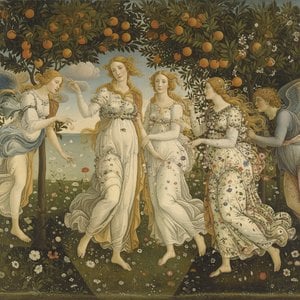
Jacopino del Conte: A Florentine Mannerist Bridging Rome and Florence
Jacopino del Conte (c. 1510 – 1598) stands as a compelling figure within the vibrant tapestry of 16th-century Italian art, a painter whose career unfolded across both the artistic heartland of Florence and the papal seat of Rome. Born in Florence during a period of intense artistic innovation, Conte’s life was marked by apprenticeship under the esteemed Andrea del Sarto, a master who profoundly shaped his early style. Yet, unlike many of his contemporaries, Conte didn't simply replicate his teacher’s techniques; he forged a distinct path, developing a unique Mannerist voice characterized by dramatic compositions, intricate detail, and a subtle emotional depth.
Conte’s formative years were spent absorbing the principles of Florentine Renaissance art. His initial training with Andrea del Sarto instilled in him a meticulous approach to drawing and an understanding of classical forms. However, it was through his early commissions – frescoes like the “Annunciation to Zachariah” (1536), the “Preaching of Saint John the Baptist” (1538), and the “Baptism of Christ” (1541) – that Conte truly began to establish his own artistic identity. These works, executed in the Oratory of San Giovanni Decollato in Rome, showcased a burgeoning talent for narrative storytelling and a growing interest in complex spatial arrangements— hallmarks of the emerging Mannerist style. Notably, the “Preaching” fresco drew inspiration from the masterful drawing of Perin del Vaga, demonstrating Conte’s willingness to learn from and incorporate the work of other accomplished artists.
Collaborations and Roman Influence
Conte's career took a significant turn in 1547-48 when he joined forces with Siciolante da Sermoneta on the ambitious fresco decoration of the chapel of San Remigio in San Luigi dei Francesi. This collaboration provided Conte with invaluable experience working on large-scale projects and exposed him to new techniques and compositional strategies. The resulting frescoes, though sometimes debated in terms of authorship, reveal a shared interest in dramatic lighting, dynamic figures, and intricate details—elements that would become increasingly prominent in Conte’s later work.
His time in Rome proved particularly influential. He continued to receive commissions for altarpieces and devotional paintings, often exploring themes of religious ecstasy and profound emotional states. The “Deposition” (1552), painted for the Oratory of San Giovanni Decollato, exemplifies this shift towards a more emotionally charged style. While some scholars attribute aspects of this painting to Daniele da Volterra, Conte’s distinctive use of color, drapery, and expressive gestures firmly establish his presence as the primary artist. The work demonstrates a growing departure from the idealized forms of High Renaissance art, embracing a greater sense of dynamism and psychological complexity.
Portraiture and Artistic Development
Beyond his fresco cycles, Conte also produced a series of individual portraits, most notably his portrait of Michelangelo (c. 1540). This painting offers a fascinating glimpse into the artist’s ability to capture not only physical likeness but also the personality and inner life of his subject. The portrait is characterized by its dramatic lighting, intense gaze, and subtle gestures—elements that reflect Conte's growing mastery of chiaroscuro and his increasing interest in psychological realism.
Later in his career, Conte continued to refine his style, incorporating elements of both Mannerism and the emerging Baroque. His works from this period are marked by a heightened sense of drama, intense color palettes, and dynamic compositions. The “Virgin and Child with Saint Elizabeth and John the Baptist” (1535), now housed in the Uffizi Gallery, exemplifies this evolution, showcasing a masterful command of perspective, drapery, and emotional expression.
Legacy and Historical Significance
Jacopino del Conte’s legacy lies not only in his individual works but also in his role as a pivotal figure in the transition between Mannerism and the Baroque. He bridged the gap between the refined elegance of the High Renaissance and the dramatic intensity of the new style, leaving behind a body of work that continues to captivate art historians and collectors alike. His paintings offer a valuable insight into the artistic currents of 16th-century Italy, revealing the complex interplay of influences and innovations that shaped the course of Western art history. His works are testament to his skill as both a draftsman and painter, and his ability to imbue religious scenes with profound emotional resonance.
질의응답
Jacopino del Conte의 다른 이름이나 별칭에는 무엇이 있나요?
Jacopino del Conte은(는) Iacopino del Conte, Jacopo del Conte(으)로도 알려져 있습니다.
Jacopino del Conte 작품의 연도별 타임라인이 있나요?
Jacopino del Conte의 작품을 연도별로 정리하여 보여주는 작품 연대기 페이지입니다.
키워드별로 분류된 Jacopino del Conte의 작품은 어디에서 볼 수 있나요?
특정 주제의 Jacopino del Conte 작품을 찾으려면 키워드별로 작품이 분류된 작가의 키워드별로 페이지를 이용해 보세요.