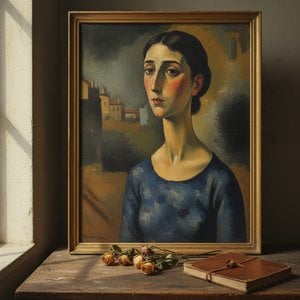
The Quiet Observer of a Changing Era
Iosif Mikhailovich Gurvich lived through a century that demanded much from those who sought to capture it on canvas. Born in 1907, he came of age during the formative years of the Soviet Union, a time when the purpose of art was often dictated by the state. He sought his training at the Vkhutemas, the Higher Art and Technical Studios, where the foundations of his craft were laid. His work did not merely record the surface of things; it sought to find a way to express the internal weight of the human experience within the rigid frameworks of Socialist Realism.
His brushwork often bridged the gap between the strict requirements of his time and a more personal, emotional depth. He was a painter who understood the quiet power of a figure or the stillness of a landscape. While he worked within the established styles of his era, there was a nuance in his approach that allowed for a sense of introspection. He did not shy away from the complexities of his subjects, choosing instead to find the human element within the social structures of the day.
A Life Captured in Form and Color
The breadth of Gurvich's output reflected a deep engagement with the world around him. He moved between different subjects with a steady hand, focusing on the essence of his models and the atmosphere of his surroundings. His technical skill allowed him to navigate various genres, ensuring that each subject was treated with a specific, thoughtful intent.
- Portraiture that sought the character of the individual.
- Figure studies exploring the human form.
- Still life compositions that found beauty in the everyday.
- Landscapes that captured the mood of the environment.
One of his notable works, At the Small Stadium "Dynamo", painted in 1958, offers a glimpse into the social life of the period. This oil on canvas work shows his ability to take a specific, perhaps even mundane, setting and imbue it with a sense of life and movement. It remains a piece that reflects his ability to balance the observational with the expressive.
Legacy and Artistic Presence
By the time of his death in 1992, Gurvich had left behind a body of work that speaks to the tension between personal feeling and public expectation. His paintings are held in significant collections, including the National Gallery of Armenia, Yerevan, which preserves several of his works. These pieces serve as a record of a man who navigated a complex historical landscape through the medium of paint and graphic art.
His contribution to the history of Soviet painting lies in this subtle navigation. He was a man of his time, yet his work often reached for something more intimate. Through his portraits and landscapes, he provided a window into the emotional reality of a generation, leaving a legacy that remains held in the care of dedicated institutions.
Q&A
Iosif Gurvich의 모든 작품을 어디에서 볼 수 있나요?
이 사이트에 등록된 Iosif Gurvich의 모든 작품은 작가의 전체 작품 보기 페이지에서 만나보실 수 있습니다.
주제별로 Iosif Gurvich의 작품을 찾아볼 수 있나요?
주제별 작품 모음 페이지에서는 Iosif Gurvich의 작품들을 주제별로 확인하실 수 있습니다.
Iosif Gurvich 작가의 다른 활동명이나 알려진 이름이 있나요?
Iosif Gurvich은(는) Iosif Mikhailovich Gurvich라는 이름으로도 활동하고 있습니다.
Iosif Gurvich 작가 작품의 컬러 프로필은 어디에서 확인할 수 있나요?
Iosif Gurvich 작가 작품의 컬러 프로필은 작가의 팔레트 지놈 페이지에서 확인하실 수 있습니다.