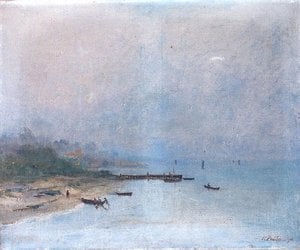
The Discipline of Observation
Strasbourg, 1824. The son of an army officer, Hippolyte Pradelles begins a life shaped by the structured gaze of a soldier's upbringing. His early training under Gabriel-Christophe Guérin and Gustave Brion provides a foundation of academic draughtsmanship, a rigorous discipline that would later anchor his more experimental impulses. He does not merely observe; he records. This precision becomes a vital tool when the theater of his life shifts from the studio to the battlefield. During the Crimean War, Pradelles serves as a corporal in the 6th Line Infantry Regiment. Amidst the chaos of conflict, he produces four drawings for L'Illustration, capturing the stark realities of landscape under the pressure of war. The experience leaves a mark on his vision, bridging the gap between formal study and the raw, unvarnished truth of the environment.
The Port-Berteau Experimentation
By 1862, the rigid lines of his academic training begin to dissolve into something more fluid. In the picturesque environs of Bussac-sur-Charente, Pradelles joins Louis-Augustin Auguin, Jean-Baptiste Corot, and Gustave Courbet to form the Port-Berteau Group. This is a moment of intense collective energy. They move outdoors, embracing the light and the immediate atmosphere of the region. Pradelles finds himself at a crossroads between the meticulous realism of his mentors and the loose, expressive brushstrokes of the burgeoning Impressionist movement. He does not abandon structure for the sake of abstraction; instead, he uses light to define the verdant valleys and sun-drenched hills of the Dordogne.
His technical evolution is marked by several distinct phases and focuses:
- The transition from draughtsman and watercolourist to a painter of oils and landscapes.
- The development of a style that balances atmospheric effects with traditional compositional principles.
- The shift from military documentation to the depiction of regional French life and genre scenes.
The Bordeaux Legacy
The dissolution of the Port-Berteau Group in 1863 marks a permanent shift in his geography. Pradelles moves to Bordeaux, establishing a studio that becomes a hub for the local artistic community. Here, he transitions into a mentor, training a new generation of painters and cementing his presence in the regional art scene. His work during this period expands to include genre scenes and portraits, such as Portrait de Monsieur Jannesse, alongside his continued devotion to the landscape. He exhibits with the Société des Amis des Arts de Bordeaux and the Société des Amis des Arts de Strasbourg, maintaining a presence in the formal art world while his style remains deeply rooted in the specificities of the French terrain. He remains in Bordeaux until his death in 1913, leaving behind a body of work that captures the tension between the old academic world and the new light of the late 19th century.
Q&A
Hippolyte Pradelles의 모든 작품은 어디에서 볼 수 있나요?
이 사이트에 등록된 Hippolyte Pradelles의 모든 작품은 작가의 전체 작품 보기 페이지에서 만나보실 수 있습니다.
미술 사조별로 분류된 Hippolyte Pradelles의 작품은 어디에서 볼 수 있나요?
Hippolyte Pradelles 작가의 작품을 예술 사조별로 모아둔 모든 미술 사조 페이지에서 해당 작가가 활동했던 사조를 확인하실 수 있습니다.
Hippolyte Pradelles의 작품을 색상별로 정렬해서 볼 수 있나요?
컬러 인덱스 페이지에서는 Hippolyte Pradelles의 작품들을 색상별로 모아 보실 수 있습니다.
특정 색상 팔레트의 Hippolyte Pradelles 작품은 어디에서 찾아볼 수 있나요?
컬러 팔레트별로 보기 페이지에서는 Hippolyte Pradelles의 작품들을 색상 팔레트별로 모아볼 수 있습니다.