Early Life, Family and Training
Herman Heuff was born on July 9, 1875, in The Hague. His early years in the Netherlands provided the foundation for a career defined by technical precision and a deep connection to the Dutch landscape. He did not merely stumble into his craft; he pursued it through rigorous formal instruction. He studied at the Haagsche Akademie and the Koninklijke Academie van Beeldende Kunsten in The Hague, honing the skills that would later define his output as a painter and graphic artist.
His development was shaped by the specific guidance of established figures. He attended evening classes at the Haagsche Akademie under Floris Arntzenius, a mentorship that anchored his technical approach. Beyond the classroom, Heuff received direct instruction from Theo van Hoytema and Willem de Zwart. These influences provided him with the necessary tools to navigate the complexities of light and form, moving him toward the atmospheric style for which he is remembered.
Personal life and professional development intersected in 1904. He married Tannetje (Tanna) Schoonakker in Zierikzee. This period marked a transition from a student of the academies to a working artist establishing his presence. His training was not a brief phase but a sustained engagement with the academic traditions of The Hague, ensuring his work remained grounded in structural competence even as his interests expanded toward etching and various printmaking techniques.
Technique, Style and Subject Matter
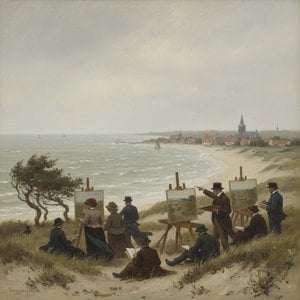
Heuff’s technical range was broad, spanning painting, etching, lithography, and ceramics. His early output aligned with the Hague School, focusing on the atmospheric qualities of the Dutch landscape. He worked primarily in oil and watercolor, but his shift toward printmaking around 1914 introduced a more graphic precision to his repertoire. This versatility allowed him to move between the delicate textures of a watercolor and the sharp, structural lines of an etching.
His subject matter centered on the quietude of specific environments. He captured harbor views, ships, and landscapes, often focusing on old neighborhoods and villages along rivers in Zeeland and South Holland. He had a particular knack for intimate city scenes rendered in small formats. These works prioritized a specific atmospheric mood over grand scale. A study trip to Italy shifted his approach; the intense effects of sunlight prompted a transition into an impressionistic style, moving away from his more somber Dutch roots toward a brighter, light-focused palette.
The artist’s ability to translate light into form defined his most effective works. Whether documenting a bustling port or a still life of flowers, Heuff focused on how light interacted with the immediate surroundings. His later transition into ceramic sculpture, specifically small clay figures of animals, demonstrated a tactile shift in his handling of form after his sight began to fail.
Later Years and Artistic Transition
Physical decline forced a significant shift in Heuff's creative output during the 1930s. After losing sight in one eye in 1931, he lost his remaining vision a year later. This loss of sight did not end his production; instead, it redirected his focus from the canvas and the etching plate toward tactile mediums. He turned to ceramics, working with clay to produce small figurines, primarily focusing on animal subjects. This transition from two-dimensional landscapes and cityscapes to three-dimensional sculpture demonstrates a pragmatic adaptation to his changing physical reality.
The severity of his condition prompted immediate community action. In June 1933, a benefit exhibition was organized to support him, leading to the establishment of the Herman Heuff Fund. This fund relied on the generosity of fellow artists who provided works for auction to provide for his needs. Even in this period of visual impairment, his commitment to making art remained constant. He continued to work until his death on July 1, 1945, at his home, de Dorstige Kuil, in Heemstede.
Legacy and Museum Collections
Heuff’s influence extended into the visual language of later Dutch illustration, notably acting as an inspiration for Anton Pieck. This connection highlights the lasting impact of his atmospheric compositions on the aesthetic direction of the era. His social standing and the quality of his output were recognized by the highest levels of Dutch society; during the benefit auction organized in 1933, Queen Wilhelmina was among the buyers of his work.
The physical presence of his oeuvre is secured in several significant Dutch institutions. His paintings are held in the collection of the Gemeentemuseum Den Haag. Additionally, his works are part of the holdings at the Teylers Museum in Haarlem. These placements ensure that his contributions to the Hague School and his later ceramic works remain accessible for study and preservation.
Q&A
Herman Heuff의 작품 중 조회수가 가장 높은 것은 무엇인가요?
이 사이트에서 Herman Heuff의 작품에 관한 통계를 확인할 수 있는 방문 통계 페이지를 만나보세요.
키워드로 Herman Heuff의 작품을 찾아볼 수 있나요?
특정 주제의 Herman Heuff 작품을 찾으려면 키워드별로 작품이 분류된 작가의 키워드별 탐색 페이지를 이용해 보세요.
Herman Heuff의 작품을 색상별로 정렬해서 볼 수 있나요?
Herman Heuff의 작품은 작가의 컬러 인덱스 페이지에서 색상별로 감상하실 수 있습니다.
Herman Heuff의 작품을 매체별로 찾아볼 수 있나요?
모든 매체별 페이지에서는 Herman Heuff의 작품을 기법별로 모아볼 수 있습니다.