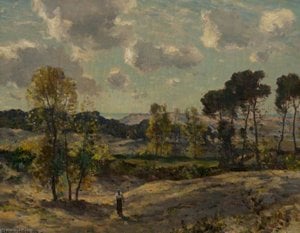
Sir Herbert Hughes-Stanton: A Master of Light and Landscape
Sir Herbert Edwin Pelham Hughes-Stanton (1870-1937) remains a quietly significant figure in the history of British watercolour painting, a master whose evocative landscapes captured the essence of both the English countryside and the dramatic beauty of France. Born into an artistic lineage – his father, William Hughes, was a respected still-life painter – Herbert’s early exposure to art instilled within him a deep appreciation for observation and meticulous technique. His career unfolded across several decades, marked by consistent dedication to his craft and a measured rise through the ranks of the Royal Academy, culminating in knighthood and recognition as President of the Royal Watercolour Society. Hughes-Stanton's legacy lies not in flamboyant exhibitions or revolutionary styles, but rather in the quiet power of his paintings – works that possess an undeniable serenity and a profound understanding of light and atmosphere.Early Life and Artistic Training
Herbert Hughes-Stanton’s childhood was steeped in artistic influence. Raised in Chelsea, London, he received his initial training under his father, William Hughes, absorbing the principles of observation and tonal control that would become hallmarks of his own style. Corsham, a small town near Bath, provided a crucial environment for developing his skills – a place where he could immerse himself in the natural world and hone his ability to translate its complexities onto paper. This early grounding fostered a deep connection with the landscape, a connection that would inform every subsequent painting. He was educated at Corsham School, where he developed an appreciation for the beauty of the surrounding countryside. His artistic journey began modestly, exhibiting his work in 1886, and quickly established itself within the established art circles of London, gaining recognition through exhibitions at prestigious venues such as the Grosvenor Gallery and the New Gallery.A Parisian Influence: Landscapes of France
Hughes-Stanton’s artistic trajectory shifted dramatically with his relocation to France in 1906. This period proved transformative, profoundly influencing his palette, composition, and overall approach to landscape painting. He spent several years immersed in the French countryside, capturing the light and atmosphere of regions like Pas de Calais and Normandy. His paintings from this era are particularly noteworthy for their subtle shifts in colour and texture – a masterful demonstration of how he rendered the effects of sunlight on water, sand, and foliage. The dramatic landscapes of the Côte d’Azur also found their way onto his canvases, showcasing his ability to capture both the grandeur and the intimacy of these coastal regions. His time in France was not merely a period of travel; it represented a deliberate immersion into a different artistic tradition, one that encouraged him to refine his skills and broaden his visual vocabulary.Royal Recognition and Artistic Leadership
Hughes-Stanton’s dedication and consistent quality eventually earned him recognition within the most esteemed circles of the British art world. He was elected an Associate of the Royal Academy in 1913, a significant step towards full membership. This honor solidified his position as a respected contemporary artist. In 1920 (or possibly 1919), he achieved the ultimate recognition by being fully admitted to the Royal Academy – a testament to his enduring talent and commitment. Further solidifying his influence, he was knighted in 1923, acknowledging his contributions to British art and culture. Beyond his individual achievements, Hughes-Stanton also played a vital role as President of the Royal Watercolour Society from 1920 until his death in 1937, guiding the organization through a period of growth and development.Legacy and Artistic Significance
Sir Herbert Hughes-Stanton’s paintings are characterized by their understated elegance, remarkable technical skill, and profound sensitivity to light and atmosphere. He eschewed dramatic gestures or overtly expressive brushwork, instead favoring a more subtle approach – one that allowed the landscape itself to speak for itself. His works often depict scenes of quiet beauty: rolling hills, shimmering water, and sun-drenched meadows. Hughes-Stanton’s paintings are held in numerous collections across Britain and internationally, including the Tate Gallery, the Welsh National Gallery, and museums in France and Japan. While he may not be as widely celebrated as some of his contemporaries, his quiet mastery and enduring appeal ensure that his landscapes continue to resonate with viewers today – a testament to the power of observation, discipline, and a deep appreciation for the beauty of the natural world. His work stands as a subtle but significant contribution to the rich tapestry of British watercolour painting.질의응답
Herbert Edwin Pelham Hughes Stanton의 다른 이름이나 별칭에는 무엇이 있나요?
Herbert Edwin Pelham Hughes Stanton은(는) Herbert Hughes-Stanton, Hughes-Stanton라는 다른 이름으로도 알려져 있습니다.
Herbert Edwin Pelham Hughes Stanton의 작품 중 몇 점을 둘러보실 수 있나요?
모든 작품 보기 페이지에서 Herbert Edwin Pelham Hughes Stanton의 작품 작품 45점점을 만나보실 수 있습니다.
Herbert Edwin Pelham Hughes Stanton의 연도별 활동 기록이 있나요?
Herbert Edwin Pelham Hughes Stanton의 예술적 여정은 연대기 페이지에서 시기별로 펼쳐집니다. 이곳에서는 작가의 활동 시기를 장(chapter)으로 나누어 작품들을 연대순 타임라인 형태로 한눈에 확인할 수 있습니다.