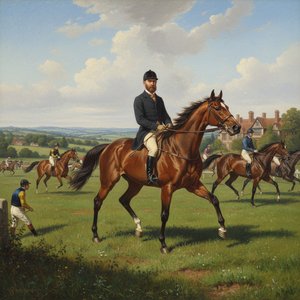
Early Life and the Allure of the Track
Henry Stull, born in Hamilton, Canada, in 1851, possessed a destiny seemingly intertwined with the thundering hooves and vibrant energy of the racehorse. Though legend whispers he arrived into the world above a stable—a charming anecdote perhaps embellishing his preordained path—his father’s profession as a horse-drawn hack driver undoubtedly instilled an early fascination with these magnificent creatures. Young Henry initially harbored ambitions for the stage, relocating to Toronto around 1870 in pursuit of an acting career. However, fate had other plans. Unable to secure a role, he found employment at an insurance firm, a temporary detour from his artistic inclinations that would soon be superseded by a more compelling calling.
The move to Brooklyn, New York City, marked a turning point. While briefly finding work painting stage sets, it was the city’s bustling racetracks that truly captured his imagination. Stull's innate talent for observation and sketching led him to Frank Leslie, editor of Leslie’s Weekly, where he began as a cartoonist and caricaturist in 1873. This position provided valuable experience but it was the horses—specifically, the thoroughbreds competing at Jerome Park—that ignited his artistic passion.
From Caricature to Canine Precision
Stull’s breakthrough came through a chance sketch of “Fiddlesticks,” a racehorse owned by August Belmont. He meticulously copied the initial drawing onto higher-quality paper and submitted it to Sporting New Yorker, where it caught Belmont's eye. This fortuitous encounter led to an illustration job with Spirit of the Times in 1876, a position he held for fourteen years. It was during this period that Stull transitioned from general illustration to specializing in racehorse portraits, catering to the wealthy patrons who populated the racing world.
Recognizing a need to refine his anatomical understanding, Stull dedicated a year to studying horse anatomy at a veterinary college. This commitment to accuracy elevated his work, imbuing it with a realism that resonated with discerning collectors. His paintings weren’t merely representations of horses; they were celebrations of their power, grace, and individual character. He quickly became known for flattering portraits, highly accurate in musculature, attracting the attention of prominent horse owners like William Whitney, Pierre Lorillard, and Leonard Jerome.
A Master of Equestrian Portraiture
By the late 19th century, Henry Stull had established himself as one of America’s foremost equestrian artists. His work graced the pages of Harper's Weekly from 1883 onwards, solidifying his reputation and expanding his clientele. He wasn’t simply a painter; he was a chronicler of an era—capturing the spirit of the American racehorse and the opulent world surrounding it.
Stull’s process involved meticulous preparation. He would travel to horse farms in Kentucky, immersing himself in the environment and sketching horses in their natural settings before completing the portraits in his New York City studio. He wasn't merely an observer; he was a participant, betting on races and even owning a horse named Brad Law, whose portrait he painted in 1902.
Legacy and Historical Significance
Henry Stull’s prolific career spanned from the late 1870s to 1912, resulting in over 110 surviving paintings. His works were highly sought after by New York and Brooklyn jockey clubs, with each club boasting between five and fifty of his pieces at one time. He captured not just the likeness of these animals but also a sense of their vitality and competitive spirit.
Stull’s death in 1913 coincided with the closure of Brighton Beach track—a symbolic end to an era he so vividly portrayed. His paintings remain as valuable historical documents, offering a glimpse into the world of late 19th-century American horse racing and the individuals who shaped it. His legacy continues through his captivating images, celebrated for their artistic merit, anatomical precision, and enduring appeal.
- Key Influences: Edward Troye (another prominent equestrian artist), Frank Leslie (editor of Leslie’s Weekly).
- Major Achievements: Establishing himself as a leading equestrian portraitist, chronicling the American racehorse and its world.
- Historical Significance: Providing valuable visual documentation of late 19th-century horse racing culture and the lives of prominent horse owners.
Q&A
Henry Stull의 작품을 색상별로 정렬해서 볼 수 있나요?
Henry Stull의 컬러 인덱스에서는 작가의 작품들을 색상별로 모아 보실 수 있습니다.
Henry Stull의 작품을 팔레트별로 모아둔 곳은 어디인가요?
Henry Stull의 작품은 작가의 컬러 팔레트별로 보기 페이지에서 컬러 팔레트별로 만나보실 수 있습니다.
Henry Stull의 작품 중 몇 점을 둘러보실 수 있나요?
전체 작품 보기 페이지에서 Henry Stull의 작품 작품 2점점을 만나보실 수 있습니다.
Henry Stull의 모든 작품은 어디에서 볼 수 있나요?
이 사이트에 등록된 Henry Stull의 모든 작품은 작가의 전체 작품 보기 페이지에서 만나보실 수 있습니다.