A Life Defined by Fragility and Vision
The story of Henry Liverseege is one of profound paradox, where a physically broken body housed an extraordinarily vibrant and imaginative spirit. Born in Manchester in 1802, Liverseege’s early years were shadowed by severe physical infirmities that would ultimately claim his life at the tender age of thirty. He lived with chronic asthma and a spinal deformity known as scoliosis, which left him with a noticeably uneven silhouette. The sheer fragility of his existence was such that, upon his untimely death in 1832, it was revealed that one of his lungs had failed to develop entirely. This physical struggle was compounded by personal tragedy; rejected by his father, Edmund, a local joiner, the young artist was raised by his uncle, John Green, a prosperous cotton mill owner. It was this familial support that provided the stability necessary for Liverseege to transform his internal struggles into a lasting artistic legacy.
Despite the limitations imposed by his constitution—at times weighing as little as seventy pounds—Liverseege possessed an unyielding drive to communicate through visual storytelling. His early creative impulses were not found in the grand halls of academies, but in the humble, tactile world of local commerce and performance. Before he became a master of the literary genre, he found footing in the practical arts, designing inn signs and painting modest portraits for small commissions. These early endeavors, though perhaps viewed by contemporaries as mere trades, served as the foundational training ground where he learned to capture the essence of character and the subtle play of light upon a subject.
The Romantic Soul and Literary Landscapes
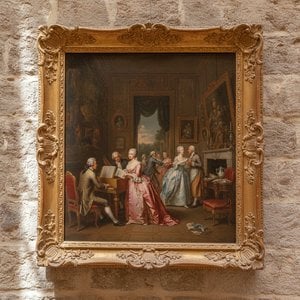
As his talent matured, Liverseege’s focus shifted from the literal to the legendary. Around 1826, he began to move away from portraiture toward a more ambitious specialization in genre paintings that drew heavily from the wellspring of literature and folklore. He became a painter deeply embedded in the Romantic movement, finding his greatest inspiration in the sweeping narratives of Sir Walter Scott. The dramatic tension, historical weight, and folkloric richness of Scott’s novels provided the perfect canvas for Liverseege’s meticulous eye for detail and his ability to evoke deep emotion.
His work often functioned as a visual bridge between the written word and the viewer's imagination. He had a remarkable gift for populating his canvases with characters that felt plucked directly from the pages of a classic novel—figures caught in moments of quiet reflection, sudden peril, or intense drama. His technique was characterized by a certain dramatic realism; he did not merely illustrate scenes but sought to imbue them with a sense of lived history and atmospheric depth. Whether depicting Shakespearean figures like Sir John Falstaff or scenes steeped in English folklore, his brushwork aimed to capture the psychological truth of his subjects.
A Legacy Cut Short
The trajectory of Liverseege’s career remains one of the great "what ifs" of nineteenth-century British art. His death in 1832 silenced a voice that was only just beginning to find its full resonance within the Royal Academy and the wider art world. There is a poignant consensus among historians that had he been granted more time, his talent would have undoubtedly secured him a place among the giants of his era. He left behind a body of work that serves as a testament to the triumph of creativity over physical adversity.
Today, Liverseege is remembered not just for the technical skill displayed in his oil paintings and watercolours, but for the evocative power of his storytelling. His contributions to the genre painting tradition remain significant, offering a window into the Romantic sensibilities of the early Victorian period. His life remains a hauntingly beautiful narrative of an artist who, though confined by the limits of his own breath, managed to capture the boundless spirit of human legend.
질의응답
Henry Liverseege의 경력은 어떻게 시기별로 구분되어 있나요?
Henry Liverseege의 연대기는 작가의 활동 시기별로 분류된 작품들을 연대순으로 보여주는 스크롤 방식의 타임라인입니다.
Henry Liverseege의 작품 중 조회수가 가장 높은 것은 무엇인가요?
Henry Liverseege의 작품에 관한 통계를 보여주는 통계 페이지가 본 웹사이트에 마련되어 있습니다.
Henry Liverseege은(는) 어느 시대에 활동했나요?
Henry Liverseege은(는) 19th Century 시대에 활동했습니다. 이 시기는 역사적 맥락에서 작가의 활동 위치를 보여줍니다.