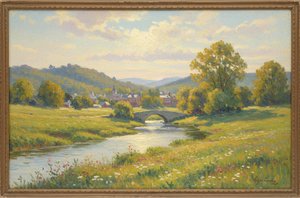
The Chronicler of York: Henry Cave and the Topographical Spirit
Henry Cave (1779-1836), though perhaps less celebrated than some of his contemporaries, occupies a unique and vital position in the history of English art. He wasn’t driven by grand historical narratives or allegorical ambition; instead, he dedicated his considerable talent to meticulously documenting the city of York – its buildings, streets, and daily life – creating a visual record that remains an invaluable resource for understanding 19th-century England. Born into a world undergoing rapid change, Cave eschewed the burgeoning Romantic movement’s focus on sublime landscapes and instead turned his attention inward, finding beauty and significance in the familiar fabric of urban existence. His work is not merely topographical; it's imbued with a quiet affection for York, transforming architectural renderings into evocative portraits of a living city.Early Life and Artistic Training
Details surrounding Cave’s early life remain somewhat scarce. He was born Henry Meyrick Cave-Browne-Cave, suggesting a family of some standing, though the extent of their influence on his artistic development is unclear. What *is* known is that he received formal training in watercolour painting, a medium perfectly suited to his precise and detailed style. Watercolour’s portability allowed him to work directly from life, capturing fleeting moments of light and atmosphere with remarkable accuracy. This dedication to direct observation would become the hallmark of his oeuvre. He initially worked under the name Henry Meyrick, later adopting Cave as his primary artistic signature. The choice likely reflects a desire for professional clarity in an era where artists often used multiple aliases. His early works demonstrate a clear understanding of perspective and composition, hinting at a rigorous academic foundation.A City in Watercolour: Cave’s York
Cave's enduring legacy rests upon his extensive series of watercolour paintings depicting York. He didn’t simply paint iconic landmarks like York Minster – though he rendered these with stunning detail – but focused on the everyday scenes that constituted the city’s character. Cobbled streets bustling with activity, shops overflowing with goods, and domestic interiors reveal a keen eye for social observation. His palette is typically restrained, favouring muted tones that evoke a sense of atmosphere and authenticity. He wasn't interested in idealizing York; rather, he presented it as it was – a working city, full of life, grime, and the subtle beauty of weathered stone. This commitment to realism distinguishes him from many of his contemporaries who favoured more picturesque or dramatic subjects. His work provides an unparalleled glimpse into the lives of ordinary people in early 19th-century England.Technique and Influences
Cave’s technique was characterized by a remarkable precision and attention to detail, achieved through layers of delicate watercolour washes. He employed fine brushes and a steady hand to render architectural features with astonishing accuracy. While he didn't explicitly align himself with any particular artistic school, his work reveals influences from earlier topographical artists like Samuel Buck and Paul Sandby. However, Cave’s paintings possess a greater sense of intimacy and narrative detail than those of his predecessors. He wasn’t merely recording buildings; he was capturing the spirit of a place. The influence of Dutch Golden Age painting – particularly the work of Johannes Vermeer – can also be detected in his meticulous rendering of interiors and light effects. His use of light is subtle but effective, creating a sense of depth and atmosphere that draws the viewer into the scene.Legacy and Historical Significance
Although Cave did not achieve widespread fame during his lifetime, his work has gained increasing recognition in recent years as scholars have come to appreciate its historical and artistic value. His paintings provide an invaluable visual record of York at a time of significant social and economic change. They offer insights into the city’s architecture, street life, and daily routines that would otherwise be lost to history.- His meticulous documentation serves as a crucial resource for architectural historians.
- Social historians value his paintings for their depiction of everyday life in early 19th-century England.
- Art collectors prize his work for its technical skill and atmospheric quality.
Q&A
Henry Cave 작가의 작품을 감상할 수 있는 3D 갤러리는 어디인가요?
Henry Cave의 작품은 작가의 3D 갤러리 페이지 내 3D 갤러리에서 감상하실 수 있습니다.
Henry Cave의 작품을 컬러 팔레트별로 둘러볼 수 있나요?
특정 색상 팔레트의 Henry Cave 작품을 찾으시려면, 작가의 컬러 팔레트별로 보기 페이지를 이용해 보세요.
Henry Cave의 작품 전체 목록을 볼 수 있는 곳이 있나요?
이 사이트에 등록된 Henry Cave의 모든 작품은 작가의 전체 작품 보기 페이지에서 만나보실 수 있습니다.
Henry Cave의 작품을 분위기별로 찾아볼 수 있나요?
Henry Cave의 작품은 각 작품이 지닌 분위기에 따라 분류된 무드 룸 페이지에서 무드별로 감상하실 수 있습니다.