A Life Shaped by Light and Form
Born in Saginaw, Michigan, Henry Carter Johnson grew up in the industrial landscape of Detroit. He did not follow a traditional academic path in the arts. Instead, he learned through observation and practice, working as a janitor for a painter at the Detroit School of Fine and Applied Arts. This early exposure provided a quiet education that stayed with him throughout his life. By the 1930s, he found himself in New York City, a period that would fundamentally change the direction of his creative output.
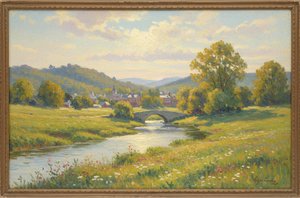
During the Great Depression, he contributed to the Federal Art Project as a WPA artist. His work during this era focused on the landscapes of the Midwest, capturing the sprawling farmlands and the subtle marks of industrialization. This period of his life was defined by a deep connection to the American landscape, a theme that would later find new expression through different mediums.
The Art of the Miniature
The war years brought a shift in his focus. While serving in the Pacific Theater during World War II, he applied his visual skills to more practical needs, working as a photographer and surgical artist for the U.S. Army Medical Corps. When he returned to Michigan, he turned his attention toward a medium that required immense precision and heat: glass.
He became a self-taught glassmaker, developing a technique that was far from the traditional method of blowing glass. Instead, he worked with colored glass rods, heating them to temperatures as high as 3000 degrees Fahrenheit. He would mold the molten material, which had the consistency of thick molasses, into delicate shapes. This process required a careful understanding of temperature, as reheating the glass too often could alter its color or composition.
His glasswork was characterized by several distinct subjects:
- Small animal figurines, often referred to as "Critters," including deer, snakes, fish, and bunnies.
- Human likenesses, such as ballerinas and acrobats.
- Floral forms and various landscape-inspired pieces.
While his official business was titled "Fine Miniatures in Glass," his fans affectionately called his collection "The Glass Menagerie."
A Legacy in Michigan
In his later years, Johnson lived in Ferry, Michigan, where he continued to fashion his glass figures until his death in 1996. His ability to capture the essence of a creature in a small, translucent form earned him a place in significant collections, including the Smithsonian American Art Museum and the Henry Ford Museum. Beyond his glasswork, he was a nature photographer whose images appeared in publications like the New York Times and Natural History Magazine.
Q&A
Henry Carter Johnson의 다른 이름이나 별칭에는 무엇이 있나요?
Henry Carter Johnson은(는) The Glass Menagerie라는 이름으로도 활동하고 있습니다.
Henry Carter Johnson 작가의 작품을 감상할 수 있는 가상 박물관에 방문할 수 있나요?
Henry Carter Johnson의 3D 갤러리는 작가의 작품들을 가상 3D 갤러리로 감상할 수 있는 페이지입니다.
Henry Carter Johnson의 작품을 사조별로 둘러볼 수 있나요?
Henry Carter Johnson의 작품은 작가의 모든 미술 사조 페이지에서 사조별로 만나보실 수 있습니다.
Henry Carter Johnson 작가의 작품을 연도별로 어떻게 확인할 수 있나요?
Henry Carter Johnson의 작품 연표를 확인해 보세요: 작품 연대기 페이지에서 작품들을 제작 날짜순으로 보실 수 있습니다.