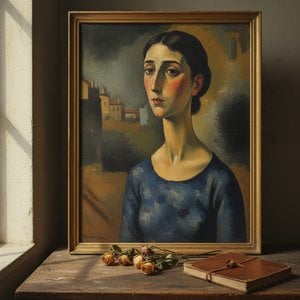
The Naturalist Impulse
The air in the studios of the late nineteenth century shifts as Manuel Henrique Pinto enters the scene. Born in Cacilhas, he becomes a central figure in the first wave of Naturalism. He does not merely observe; he participates in the social fabric of the art world, a member of the influential Grupo do Leão. In the crowded, smoke-filled rooms of the era, he sits at the table alongside his contemporaries, his presence captured in the collective memory of his peers. His work moves away from the rigid formalities of the past, seeking instead the raw, unvarnished truth of Portuguese life.
His brush captures the quietude of the rural landscape and the rhythmic labor of the peasantry. There is a specific gravity to his subjects, whether they are tending to crops or gathered in a simple domestic setting. He finds a particular resonance in the light of the Alentejo and the small, intimate scenes of Portalegre. His vision is grounded, focused on the tangible textures of existence.
Recognition and Academic Influence
The progression of his career is marked by a steady accumulation of honors that reflect his technical command and his commitment to the naturalist cause. His ability to translate the essence of a scene onto canvas earns him significant accolades during the height of his activity:
- A 3rd Class Medal with distinction in 1884 for the work "Na Horta".
- A Copper Medal awarded in 1888.
- A Gold Medal in 1908, received in Rio de Janeiro.
Beyond the canvas, Pinto’s influence extends into the classroom. He shapes the next generation of artists through his roles as a professor and director. His leadership at the Escola de Desenho Industrial Fradesso da Silveira in Portalegre and later at the Escola Jacôme Ratton in Tomar ensures that his dedication to formal training and industrial drawing remains a cornerstone of his legacy.
The Final Years
The evolution of his style sees him moving through various iterations of a single theme, often renaming his works to better capture a shifting mood or a new light. A scene might begin as "Limpando o Milho" before settling into a title like "Na Eira" or "Uma Manhã de Figos." This fluidity suggests an artist deeply preoccupied with the nuances of a single moment. He captures the mundane—the feeding of pigs, the gathering of blackberries, the quietude of a mother—and treats these subjects with a profound, observational seriousness.
His life concludes in Figueiró dos Vinhos, leaving behind a body of work that remains anchored in the soil and the light of his homeland. His presence in the history of Portuguese painting is defined by this refusal to look away from the reality of the everyday.
Q&A
Henrique Pinto의 작품을 색상별로 정렬해서 볼 수 있나요?
Henrique Pinto의 작품은 작가의 컬러 인덱스 페이지에서 색상별로 감상하실 수 있습니다.
키워드별로 분류된 Henrique Pinto의 작품은 어디에서 볼 수 있나요?
Henrique Pinto의 키워드별 탐색 페이지에서는 작가의 작품들을 키워드별로 모아볼 수 있습니다.
Henrique Pinto의 작품 중 몇 점을 둘러보실 수 있나요?
전체 작품 보기 페이지에서 Henrique Pinto의 작품 작품 9점점을 만나보실 수 있습니다.
Henrique Pinto의 연도별 활동 기록이 있나요?
Henrique Pinto의 예술적 여정은 연대기 페이지에서 시기별로 펼쳐집니다. 이곳에서는 작가의 활동 시기를 장(chapter)으로 나누어 작품들을 연대순 타임라인 형태로 한눈에 확인할 수 있습니다.