Heinrich Nauen: A Rhineland Visionary
Born in Krefeld, Germany, in 1880, Heinrich Nauen’s artistic journey was one of quiet observation and profound emotional resonance. His early life, marked by a family of bakers, provided a grounding contrast to the burgeoning artistic spirit that would soon consume him. Unlike many artists who sought grand urban centers, Nauen found his creative haven in the Rhineland, a region steeped in folklore, rural beauty, and a deep connection to the land – influences that would irrevocably shape his distinctive style.
Nauen’s formal training began at the Kunstakademie Düsseldorf in 1898, where he honed his skills under the tutelage of established masters. However, it was his subsequent studies at the Staatliche Akademie der Bildenden Künste Stuttgart from 1900 to 1902 that truly ignited his artistic fire. This period exposed him to a wider range of techniques and perspectives, including the burgeoning influence of Vincent van Gogh’s expressive brushwork and vibrant color palette. He later sought inspiration in Paris, immersing himself in the Fauvist movement and absorbing its bold experimentation with form and hue. These diverse influences coalesced into a uniquely personal vision – one characterized by a meticulous attention to detail, a subtle yet powerful use of light and shadow, and an underlying current of melancholy.
Floral Still Lifes and Rural Landscapes
Nauen’s artistic output is predominantly defined by two recurring themes: exquisitely rendered floral still lifes and evocative landscapes of the Rhineland. His floral paintings are not merely depictions of beauty; they are intimate studies of texture, color, and form. He meticulously captured the delicate veins of petals, the velvety sheen of blossoms, and the subtle gradations of light that transform a simple bouquet into a miniature world of sensory detail. These works possess an almost photographic precision, yet they also radiate a palpable sense of warmth and quiet contemplation.
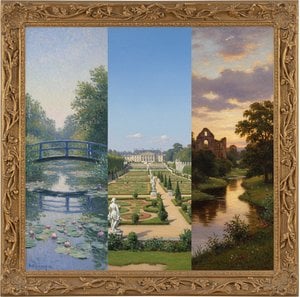
Equally compelling are his landscapes. Nauen’s depictions of the Rhineland—rolling hills, dense forests, and meandering rivers—are imbued with a profound sense of place. He avoided dramatic vistas or heroic compositions, instead favoring intimate scenes that captured the subtle rhythms of rural life. His paintings aren't about grand pronouncements; they are about quiet moments – a farmer harvesting his crops, a solitary figure contemplating the landscape, or the dappled sunlight filtering through the trees. He employed a muted palette and a restrained brushstroke to convey a sense of timelessness and serenity.
The Influence of Expressionism
While Nauen’s work predates the formal establishment of German Expressionism, it undeniably shares many key characteristics with the movement. His use of intense color, distorted forms, and emotionally charged subject matter—particularly in his landscapes—reflects a desire to express inner feelings rather than simply represent external reality. The emotional intensity found in his paintings is often subtle, but deeply felt, creating an atmosphere of introspection and vulnerability.
However, Nauen’s style retains a distinct individuality. Unlike some Expressionists who embraced bold abstraction or violent imagery, Nauen maintained a commitment to realism, albeit one filtered through the lens of personal experience. His work is characterized by a quiet dignity and a profound respect for the natural world – qualities that set him apart from his more overtly radical contemporaries.
A Life Interrupted
Heinrich Nauen’s career was tragically cut short by World War I and the subsequent rise of the Nazi regime. Following the war, he found himself embroiled in the formation of the “Young Rhineland” artists' group, a collective dedicated to promoting regional art. However, his work was deemed "degenerate" by the Nazis, leading to its confiscation and destruction. Nauen and his wife, Marie, retreated to Kalkar, where he succumbed to stomach cancer in 1940.
Despite the devastation of war and persecution, Nauen’s legacy endures. His paintings—particularly his floral still lifes—are now recognized as significant examples of German Expressionism, offering a poignant glimpse into the soul of a talented artist who found solace and inspiration in the beauty of the Rhineland.
Q&A
Heinrich Nauen 작가의 작품에서 가장 자주 나타나는 색상은 무엇인가요?
Heinrich Nauen의 팔레트 지놈에서는 작가의 작품 세계를 구성하는 컬러 프로필을 확인하실 수 있습니다.
Heinrich Nauen 작가의 작품을 감상할 수 있는 가상 박물관에 방문할 수 있나요?
Heinrich Nauen의 작품은 작가의 3D 갤러리 페이지 내 3D 갤러리에서 감상하실 수 있습니다.
Heinrich Nauen의 작품 중 몇 점을 둘러보실 수 있나요?
전체 작품 보기 페이지에서 Heinrich Nauen의 작품 작품 22점점을 만나보실 수 있습니다.