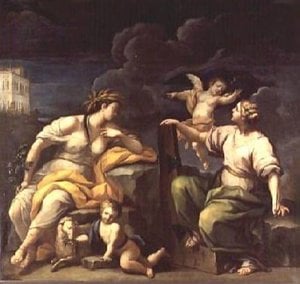
Hans Speckaert: A Northern Mannerist Bridging Italy and Belgium
Hans Speckaert (c. 1540 – c. 1577) remains a captivating figure in the history of Flemish art, a painter whose career unfolded across continents and whose work embodies the complex currents of the Northern Renaissance. Born in Brussels, Belgium, he navigated the artistic landscape of 16th-century Europe with a distinctive style that blended Italian influences with his native Flemish traditions, ultimately establishing himself as one of the key representatives of the burgeoning Mannerist movement. While details about his early life remain somewhat elusive – largely pieced together from biographical accounts like those by Karel van Mander – it’s clear he received training within the established artistic circles of Brussels, potentially under the tutelage of Pieter de Kempeneer (also known as Pedro Campaña).Early Years and Italian Sojourn
Speckaert's journey took him to Italy around 1566, a pivotal moment that profoundly shaped his artistic development. Italy at this time was the epicenter of Renaissance innovation, and Speckaert immersed himself in the works of masters like Michelangelo, Raphael, and Rosso Fiorentino. This exposure wasn’t merely observational; he actively studied their techniques, particularly their masterful use of anatomy, composition, and dramatic lighting – elements that would become hallmarks of his own style. He joined a group of Northern painters working in Rome, creating a vibrant community where artistic ideas were freely exchanged and debated. The documented dispute with the Brussels Painters’ Guild over work performed in Rome highlights the complexities of navigating professional boundaries within this international environment.Style and Technique: A Synthesis of Influences
Speckaert's art is characterized by a remarkable synthesis of influences. He inherited from his Flemish roots a meticulous attention to detail, a refined draftsmanship, and a deep understanding of color. However, he was deeply impacted by the innovations of Italian Mannerism – evident in his elongated figures, dynamic poses, and often theatrical compositions. His drawings, in particular, demonstrate an extraordinary command of line and a fluid elegance that exerted considerable influence on subsequent generations of Northern artists, including Bartholomeus Spranger and Hans von Aachen. His work frequently employed *chiaroscuro*—the dramatic contrast between light and dark—to heighten emotional impact and create a sense of depth and volume.Notable Works and Subjects
Speckaert’s oeuvre, though relatively small, showcases his versatility across various genres. He excelled in portraits, often depicting them with an aristocratic bearing and subtle psychological insight. His history paintings, such as “Conversion of St Paul on the Road to Damascus” (Louvre), are dramatic narratives filled with movement and emotional intensity. The composition is meticulously rendered, capturing the pivotal moment of divine revelation with a palpable sense of awe and terror. Other significant works include "Moses and the Brazen Serpent" (Museo Nacional de Bellas Artes, Buenos Aires) and “Diana and Actaeon,” demonstrating his ability to convey both narrative complexity and emotional depth. His drawings, including “Jaël and Sisera” (Museum Boijmans Van Beuningen), reveal a remarkable draftsmanship and an interest in exploring the human form with expressive dynamism.Legacy and Historical Significance
Hans Speckaert’s contribution to art history lies not only in his individual achievements but also in his role as a crucial bridge between Flemish and Italian artistic traditions. He absorbed the innovations of the High Renaissance while retaining a distinctly Northern sensibility, creating a unique style that resonated with contemporary audiences. His influence extended beyond his own lifetime, shaping the work of numerous artists who followed in his footsteps. Despite the scarcity of biographical information, Speckaert’s legacy endures through his captivating paintings and drawings—testaments to a talented artist who navigated the complexities of 16th-century Europe with remarkable skill and vision. His art continues to be studied and appreciated for its technical mastery, emotional depth, and enduring beauty.Q&A
Hans Speckaert 작가의 작품에서 가장 자주 나타나는 색상은 무엇인가요?
Hans Speckaert 작가 작품의 컬러 프로필은 작가의 팔레트 지놈 페이지에서 확인하실 수 있습니다.
Hans Speckaert은(는) 어느 시대의 작품을 남겼나요?
Hans Speckaert은(는) Renaissance 시대에 활동했습니다. 이 시기는 역사적 맥락 속에서 작가의 예술적 위치를 보여줍니다.
Hans Speckaert의 작품은 얼마나 인기가 있나요?
Hans Speckaert의 방문 통계 페이지에서는 이 사이트에 등록된 작가의 작품들을 바탕으로 산출된 통계 정보를 제공합니다.
Hans Speckaert 작가의 국적은 어디인가요?
Hans Speckaert은(는) Belgium 출신입니다.