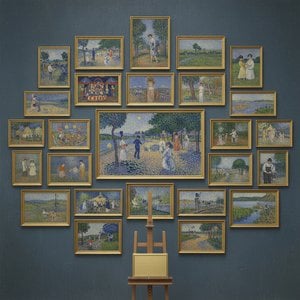
George Skelton: A Tudor Visionary Capturing Quiet Dignity
George Skelton remains a figure shrouded in relative obscurity, yet his portraits—particularly those depicting unnamed gentlemen—hold a unique fascination for art historians and collectors alike. Primarily active during the Elizabethan era, Skelton’s meticulous realism distinguishes him from many of his contemporaries, offering glimpses into a world of refined taste and subtle psychological observation rarely found elsewhere. While biographical details are scarce, surviving documentation suggests he was born in England sometime around 1560, though precise birth records remain elusive.
Skelton's artistic journey began amidst the burgeoning Renaissance fervor that swept across Europe, absorbing influences from masters of portraiture who championed naturalism and humanist ideals. These formative connections are evident in his technique: he employed oil paints on canvas with painstaking detail, meticulously layering glazes to achieve astonishing tonal accuracy and capturing minute nuances of expression. Unlike some artists of his time who prioritized grandeur and theatrical pose, Skelton favored a restrained approach, focusing instead on conveying inner character through subtle gestures and facial features.
The Art of the Unknown
His most celebrated works are undoubtedly the portraits of “unknown gentlemen,” which exemplify his distinctive style. These canvases depict men dressed in elegant attire—often richly embroidered robes—but their faces remain deliberately ambiguous. Rather than presenting idealized representations of nobility, Skelton sought to portray individuals with quiet dignity and understated intelligence. The sitter’s gaze is direct yet contemplative, hinting at inner thoughts and emotions that transcend mere appearance.
The technical mastery displayed in these works allows the viewer to appreciate the textures of the era:
- Textural Realism: The heavy weight of velvet, the intricate sheen of silk, and the delicate patterns of lace are rendered with a precision that borders on the tactile.
- Psychological Depth: Through subtle shifts in light and shadow, Skelton captures a sense of melancholy or resolve within his subjects.
- Tonal Accuracy: His use of glazes creates a luminous quality, making the skin tones appear lifelike and breathing beneath the surface of the paint.
Legacy and Historical Significance
Critics have noted the remarkable sensitivity with which Skelton captures the psychological complexities of his subjects—a trait that elevates his work from mere documentation to profound character study. In an age where portraiture often served as a tool for political propaganda or the display of wealth, Skelton’s focus on the individual's internal state provides a rare, intimate window into the Elizabethan soul. His ability to find beauty in the understated and importance in the anonymous ensures his place as a vital, if quiet, voice in the history of British Renaissance art.
질의응답
George Skelton가 그린 모든 주제를 한눈에 볼 수 있는 개요가 있나요?
George Skelton의 주제별 아틀라스는 작가의 작품들을 주제별로 분류하여 보여주는 페이지입니다.
George Skelton의 작품을 색상별로 정렬해서 볼 수 있나요?
George Skelton의 색상별 인덱스는 작가의 작품들을 색상별로 정리하여 보여주는 페이지입니다.
George Skelton의 작품 중 몇 점을 둘러보실 수 있나요?
모든 작품 보기 페이지에서 George Skelton의 작품 작품 6점점을 만나보실 수 있습니다.