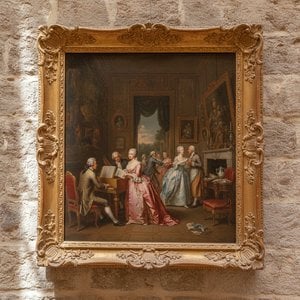
Gejza Kieselbach: A Slovak Painter of Naturalism and Rural Life
Born in Košice, Slovakia, in 1893, Gejza Kieselbach (Géza Kieselbach) emerged as a significant figure in interwar Central European art. His life’s work was deeply rooted in the landscapes and people of his homeland, particularly the rural traditions and quiet dignity of Slovak village life. Though he studied at the Munich Academy, where he benefited from the tutelage of Heinrich Zügel, Kieselbach ultimately forged a distinct artistic identity characterized by a meticulous naturalism and a profound empathy for his subjects.
Kieselbach’s early years were marked by an intense interest in art, a passion nurtured within the vibrant cultural landscape of Košice. His studies at the Munich Academy provided him with foundational skills, but it was his time under Heinrich Zügel's guidance that proved pivotal. Zügel, renowned for his realistic depictions of Bavarian landscapes and peasant life, instilled in Kieselbach a commitment to observing nature with unwavering accuracy and conveying its essence through subtle brushwork. This influence is readily apparent in Kieselbach’s later works, which share a similar focus on the details of rural existence.
Membership in the Kazinczy Group and Artistic Style
In 1924, Kieselbach joined the Kazinczy Group, a collective of Slovak artists dedicated to promoting national identity through art. This association significantly shaped his artistic trajectory, encouraging him to explore themes relevant to Slovak culture and history. However, it was not merely an adherence to group ideals that defined his style; rather, he skillfully integrated these influences with his own inherent sensibilities.
Kieselbach’s paintings are primarily characterized by a naturalistic approach, meticulously rendered figures set against the backdrop of Slovak landscapes. He excelled at capturing the textures of clothing, the weathered faces of peasants, and the subtle shifts in light and shadow. His color palette was generally subdued, favoring earthy tones—ochres, browns, greens—that reflected the muted beauty of his subjects’ environment. Compositionally, he often employed a balanced, almost symmetrical arrangement, creating a sense of quiet harmony and stability. While influenced by Zügel's realism, Kieselbach developed a unique voice, imbuing his works with a palpable sense of warmth and humanity.
Notable Works and Recognition
Several of Kieselbach’s paintings are held within the esteemed collections of the Hungarian National Gallery, testament to their artistic merit and historical significance. These works offer invaluable insights into his artistic development and thematic concerns. His depictions of rural scenes—farmers tending their fields, women spinning wool, children playing—are particularly poignant, capturing a fleeting moment in time and conveying a deep appreciation for the simple rhythms of peasant life.
Beyond the Hungarian National Gallery, Kieselbach’s art has also been featured on platforms like WahooArt.com, providing wider access to his oeuvre. The Städtische Galerie im Lenbachhaus in Munich, Germany, another notable museum, showcases artists who influenced his style, further highlighting the breadth of his artistic lineage.
Legacy and Influence
Gejza Kieselbach’s legacy extends beyond his individual works; he represents a crucial link in the chain of Slovak art history. His commitment to naturalism and his empathetic portrayal of rural life have resonated with viewers for decades. Museums such as the Rippl-rónai Museum in Kaposvár, Hungary, continue to recognize and celebrate his contributions to the artistic landscape. His work serves as a reminder of the beauty and dignity found in everyday existence—a testament to the power of art to capture and preserve the essence of a culture.
Kieselbach’s influence can be seen in subsequent generations of Slovak artists, who have drawn inspiration from his meticulous observation and his ability to imbue his paintings with profound emotional depth. He remains an important figure in understanding the development of Central European art during the interwar period, a painter whose quiet yet powerful works continue to evoke a sense of nostalgia for a bygone era.
질의응답
Gejza Kieselbach의 작품 세계는 시간이 흐름에 따라 어떻게 변화했나요?
Gejza Kieselbach의 연대기는 작가의 활동 시기별로 분류된 작품들을 연대순으로 보여주는 스크롤 방식의 타임라인입니다.
Gejza Kieselbach의 작품을 분위기별로 찾아볼 수 있나요?
Gejza Kieselbach의 무드 룸는 작가의 작품들을 분위기별로 모아볼 수 있는 페이지입니다.
Gejza Kieselbach 작가의 작품을 감상할 수 있는 가상 박물관에 방문할 수 있나요?
Gejza Kieselbach의 작품은 작가의 3D 뮤지엄 페이지에 마련된 3D 갤러리에서 감상하실 수 있습니다.