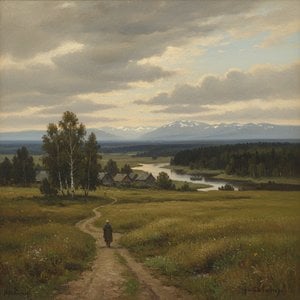
The Master of Grandeur: The Life and Legacy of Fyodor Bruni
In the golden age of Russian Romanticism, few names commanded as much awe and monumental presence as Fyodor Antonovich Bruni. Born Fedele Giovanni Baroffi Bruni in 1799, his very identity was a tapestry of cultural intersections, possessing a Swiss-Italian heritage that infused his Russian training with a distinct Mediterranean light. The son of Antonio, a skilled Swiss-Italian painter and restorer who had been brought to Russia to serve the Imperial Court, Fyodor was destined for the brush from his earliest years. His journey began within the hallowed halls of the Imperial Academy of Arts in Saint Petersburg, where he absorbed the rigorous classical foundations of masters like Alexei Yegorov and Vasily Shebuyev. Yet, it was a thirst for the sublime that would eventually drive him far beyond the borders of his homeland.
The development of Bruni’s artistry was marked by a profound dialogue between the disciplined Neoclassicism of his academy training and the burgeoning emotional intensity of the Romantic movement. Seeking to refine his vision, he traveled to Italy, a pilgrimage that would fundamentally reshape his aesthetic sensibilities. In the sun-drenched landscapes and ancient ruins of Rome, Bruni found the spiritual and historical depth necessary to fuel his grandest ambitions. It was during this period that he began to master the art of the large-scale history painting, a genre that demanded not only technical precision but an epic narrative power capable of capturing the collective imagination of an empire.
The Colossus of Russian Painting
The zenith of Bruni’s career is inextricably linked to his most staggering achievement: The Brazen Serpent. This monumental canvas, which took approximately fifteen years of painstaking labor to complete, stands as a titan of nineteenth-century art. Inspired by the biblical narrative from the Book of Numbers, the painting depicts the harrowing moment when the Jewish people, suffering under a divine plague of venomous snakes, look toward the bronze serpent for salvation. The sheer scale of the work—stretching over eight meters in width—is matched only by its dramatic intensity. When it was finally exhibited in Saint Petersburg, it was frequently compared to Karl Bryullov’s The Last Day of Pompeii, with critics hailing them as the "colossi of Russian painting."
Beyond this singular masterpiece, Bruni’s contributions to the visual landscape of Russia were vast and enduring. His work was not confined merely to the easel; he left an indelible mark on the very architecture of Saint Petersburg. His involvement in the decorative programs for Saint Isaac's Cathedral and the Kazan Cathedral showcased his ability to translate epic narrative into the permanent, sacred fabric of the city. Through his sketches and frescoes, Bruni bridged the gap between the intimate study and the public monument, ensuring that his artistic vision would be woven into the spiritual heart of the Russian capital.
A Lasting Impression on the Imperial Era
As a teacher at the Imperial Academy of Arts, Bruni played a pivotal role in shaping the next generation of Russian masters, passing on the technical rigor and dramatic flair that defined his own era. His influence extended through students like Mikhail Botkin and Arseny Meshchersky, ensuring that the lineage of high-style history painting would persist. To look upon a Bruni canvas is to witness the intersection of profound religious devotion, classical elegance, and the sweeping drama of human struggle.
The historical significance of Fyodor Bruni lies in his ability to act as a cultural bridge. He brought the warmth and dramatic light of the Italian tradition to the frost-touched grandeur of the Russian Empire, creating an art form that was simultaneously international in its language and deeply Imperial in its scale. Even today, his works remain essential touchstones for understanding the Romantic spirit, standing as enduring monuments to a time when art sought to capture the infinite within the boundaries of a frame.
Q&A
Fyodor Bruni 작가의 다른 활동명이나 알려진 이름이 있나요?
Fyodor Bruni은(는) Fidelio Bruni, Fidelio Antonovich Bruni, Fedor Antonovič Bruni, Feodor Bruni, Feodor Antonowitsch Bruni라는 이름으로도 활동하고 있습니다.
Fyodor Bruni의 출생 도시와 국가는 어디인가요?
Fyodor Bruni은(는) Italy Milan에서 태어났습니다.
Fyodor Bruni의 작품을 매체별로 찾아볼 수 있나요?
특정 매체로 제작된 Fyodor Bruni의 모든 작품을 확인하시려면, 작가의 모든 매체별 페이지를 이용해 주세요.
Fyodor Bruni 작가의 작품 관련 통계 정보는 어디에서 확인할 수 있나요?
Fyodor Bruni 작가의 작품 통계 정보는 방문 통계 페이지에서 확인하실 수 있습니다.