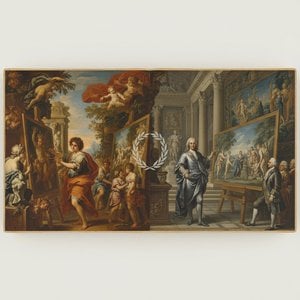
François Chauveau: Life and Legacy
Early Life and Education
Born in Paris in 1613, François Chauveau was the second son of Lubin Chauveau, a nobleman of modest means, and Marguerite de Fleurs. Despite his family’s limited financial resources, Chauveau received an artistic education, beginning his studies in the studio of Laurent de La Hyre. This foundational training proved crucial to his development as both a painter and, more notably, an engraver.
Artistic Development and Style
Chauveau quickly specialized in etching, demonstrating a natural talent for the intricate detail required by this medium. His style is characteristic of the French Baroque period – elegant, refined, and often imbued with a sense of narrative drama. While he also worked as a painter, it was his engravings that brought him widespread recognition.
Royal Patronage and Recognition
Chauveau’s talent did not go unnoticed by the French court. In 1662, Louis XIV bestowed upon him the title of Graveur du Roi (King's Engraver), along with a pension – a testament to his skill and importance. This royal patronage solidified his position within the artistic establishment. Further recognition came in 1663 when he was made a counsellor to the Académie royale de peinture et de sculpture, becoming the first printmaker admitted to this prestigious institution.
Major Works and Illustrations
Chauveau’s prolific output included nearly 1,600 works, encompassing frontispieces, vignettes, and most significantly, illustrations for numerous literary masterpieces. He is particularly celebrated for his work with:
- Mademoiselle de Scudéry: Chauveau engraved the iconic Map of Tendre and the frontispiece for her extensive novel, Artamène.
- Paul Scarron: He provided illustrations for Scarron’s comedic works.
- Molière, Racine & Boileau: Chauveau contributed his artistic talents to editions of plays and poems by these literary giants.
- Jean de La Fontaine: Perhaps his most famous collaboration was with La Fontaine, for whom he illustrated the first six books of Fables.
Influences and Legacy
Chauveau’s work demonstrates a clear influence from his teacher, Laurent de La Hyre. He, in turn, influenced a generation of engravers, including Nicolas Guérard, Jean-Baptiste Broebes, and Edward Davies.. His ability to capture both the grandeur of courtly life and the intimacy of literary narratives established him as one of the leading French engravers of his time. He was cited by Charles Perrault in his “Hommes illustres” as one of four prominent French engravers, solidifying his place in art history.
Death and Historical Significance
François Chauveau passed away in Paris in 1676. His legacy endures through the exquisite detail and narrative power of his engravings, which continue to offer valuable insights into 17th-century French art, literature, and culture.
질의응답
주제별로 분류된 François Chauveau의 작품들은 어디에서 확인할 수 있나요?
François Chauveau의 주제별 아틀라스는 작가의 작품들을 주제별로 분류하여 보여주는 페이지입니다.
François Chauveau의 출생 도시와 국가는 어디인가요?
François Chauveau은(는) France의 Paris에서 태어났습니다.
François Chauveau의 출생지와 출생 연도는 언제인가요?
François Chauveau은(는) 1613년 Paris에서 태어났습니다.