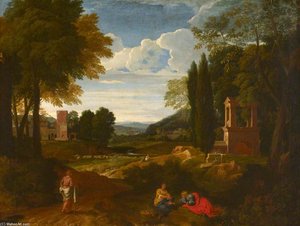
Francisque Millet: Life and Legacy
Early Life and Training
- Born in Antwerp, Belgium in 1642, Francisque Millet (also known as Jean-François Milée) was the son of a French ivory worker who had settled in the region.
- He began his artistic training with Laurentius Frank, a cousin of Abraham Genoels.
- Remarkable Talent: Genoels noted Millet’s extraordinary ability to copy artworks quickly and accurately from memory, without needing to constantly refer to the original.
- At the age of eighteen, he married his master's daughter, solidifying his position within the artistic community.
Artistic Development and Influences
- Italianate Landscapes: Millet specialized in Italianate landscapes populated with figures, a style heavily influenced by Nicolas Poussin and his brother-in-law, Gaspard Dughet.
- His work often depicted serene scenes inspired by the Roman countryside, featuring classical architecture, lush vegetation, and pastoral figures.
- Travels and Exposure: He traveled extensively throughout France, England, and Holland, gaining exposure to different artistic styles and patrons. However, he was known for spending beyond his means.
Major Works and Style
- Millet produced a substantial body of work including landscapes with religious themes like “Landscape with Christ and His Disciples” as well as mythological scenes such as "Mercury and Battus".
- Characteristic Features: His paintings are characterized by their balanced compositions, atmospheric perspective, and meticulous attention to detail.
- He skillfully integrated figures into his landscapes, creating harmonious and visually appealing scenes.
- Examples of notable works include “Imaginary Landscape”, “Italian Scene With A Shrine” and "Classical Landscape".
Later Life and Death
- Millet’s life was tragically cut short in 1679 at the age of 36.
- Sudden Illness: He succumbed to a sudden high fever that led to insanity, and he died shortly thereafter.
- He was buried in the St Nicolas-des-Champs church in Paris.
Family Legacy and Historical Significance
- Jean-François Millet II: His son, also named Jean François Millet (1666–1723), followed in his father’s footsteps and became a member of the Academy of Painting in 1709.
- The younger Millet consulted artists like Watteau to enhance the figures within his landscapes.
- Influence on Later Artists: While overshadowed by later artists with the same name, Francisque Millet’s work paved the way for subsequent generations of landscape painters.
- Mark Twain even drew inspiration from Millet's life (and the confusion surrounding his name) to write the farcical play “Is He Dead?”.
- Millet’s contribution lies in his skillful execution of Italianate landscapes and his ability to blend classical influences with Baroque sensibilities.
질의응답
Francisque Millet의 출생지와 출생 연도는 언제인가요?
Francisque Millet은(는) 1642년 Antwerp에서 태어났습니다.
Francisque Millet의 모든 작품은 어디에서 볼 수 있나요?
본 웹사이트에 등록된 Francisque Millet의 모든 작품은 작가의 모든 작품 보기 페이지에서 확인하실 수 있습니다.
Francisque Millet 작가는 어떤 사조에 참여했나요?
모든 사조 페이지에서는 Francisque Millet의 작품을 예술 사조별로 모아 볼 수 있습니다.